What Do Astronauts Eat in Space? The Tasty, Tricky, and Totally Weird World of Space Food
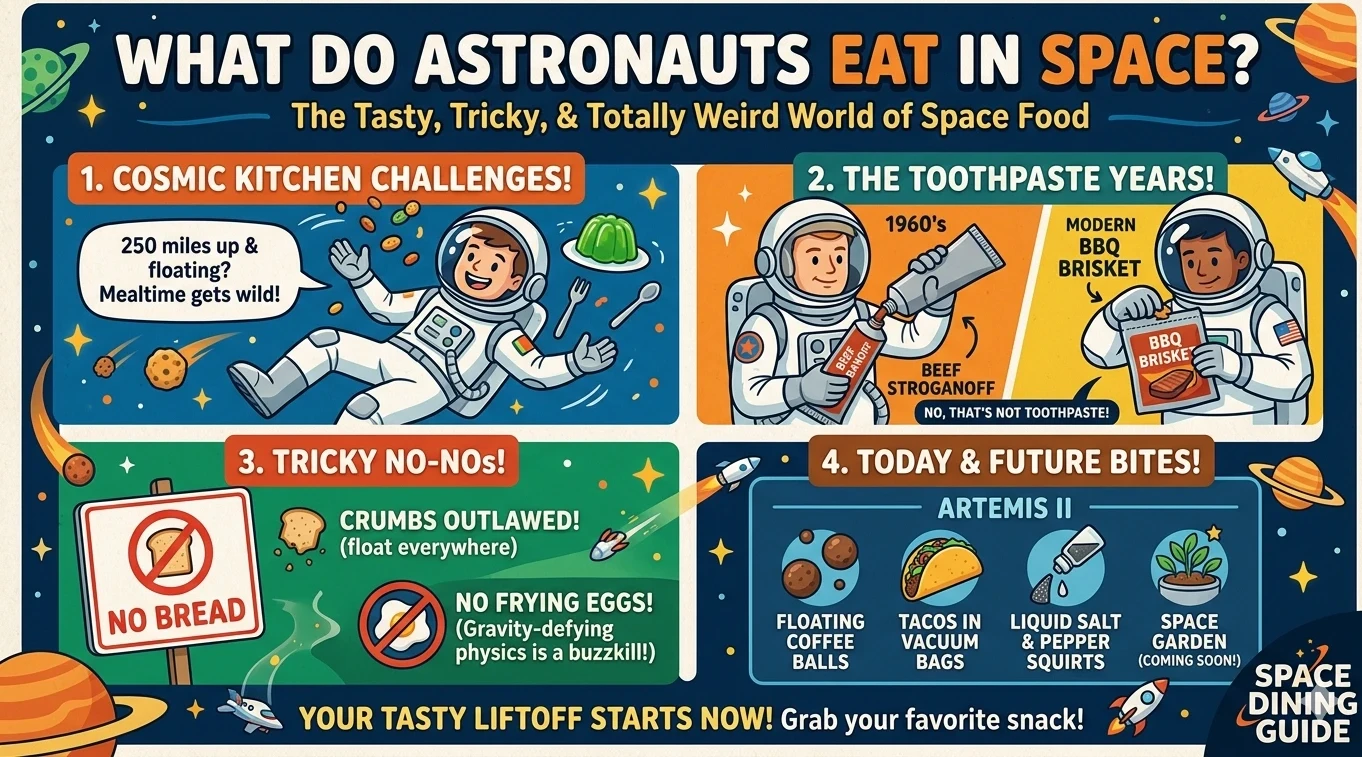
Ever stared into your fridge and thought, there’s nothing here to eat? Now, imagine saying that 250 miles above Earth, while floating upside down in your socks and trying to dunk your spoon in midair. Welcome to the cosmic kitchen! If you’ve ever looked at a tube of toothpaste and thought, “I wish that was beef stroganoff,” then you would have loved being an astronaut in the 1960s. A place where tacos come in vacuum-sealed bags, crumbs are basically outlawed, and cooking is more science experiment than kitchen hobby.
Fast forward to 2026, and the menu for the Artemis II moon mission looks less like a laboratory experiment and more like a high-end camping trip. But between the floating coffee balls and the “great bread ban,” eating in orbit is still a delightful, gravity-defying mess.
Here is everything you need to know about the tasty, tricky, and totally weird world of space food, what astronauts eat, how they prepare it, why they don’t fry eggs in space (spoiler alert: physics is a buzzkill), and what the future of dining among the stars might look like.
Grab your favorite snack and strap in. It’s going to be a tasty liftoff.
1. Why Astronaut Food Even Matters
Before we talk about freeze-dried lasagna, let’s get one thing straight: space food is serious business. Astronauts aren’t just hanging out in orbit snapping selfies of Earth — they’re working 12-hour days, constantly moving equipment, doing science experiments, and staying mentally sharp in extreme conditions.
All that brainpower and muscle needs fuel — and plenty of it.
NASA plans every single bite astronauts eat down to the vitamin. Meals have to:
- Stay safe and stable for months (no refrigerators or Uber Eats up there).
- Provide balanced nutrition — about 2,700 calories per day for men and 1,900–2,300 for women, depending on activity.
- Be easy to eat in microgravity (because food that floats = chaos).
- Taste good enough to keep morale high when you’ve seen the same hallway and crew faces for 100 days straight.
So yeah — astronaut food isn’t just “science mush.” It’s the result of decades of culinary innovation and a lot of very patient scientists taste-testing shrimp cocktails out of silver tubes.
2. What’s Actually on the Space Menu
Okay, enough suspense. What do astronauts actually eat in space?
These days, the menu aboard the International Space Station (ISS) is surprisingly familiar — think of it as “college dorm microwaveable meals if NASA had a Michelin star chef.”
Here’s what you’ll find:
- Rehydratable foods: Freeze-dried and packed so tight they could survive a zombie apocalypse. Astronauts add water with a special dispenser and voilà — instant oatmeal, soups, mashed potatoes, or scrambled eggs.
- Thermostabilized pouches: Shelf-stable meals heat-treated to last for months, kind of like those military MREs (Meals Ready to Eat). Think chicken curry, beef stew, or pasta dishes.
- Snacks: Trail mix, nuts, granola bars, and even chocolate. NASA knows morale is about 30% snacks.
- Fresh treats: Occasionally, a visiting cargo ship brings fresh fruit, tortillas, or small treats from home. These are basically space gold.
And yes, tacos are a big deal in space. Tortillas are NASA’s secret weapon because they don’t produce crumbs (which can jam filters or get into eyes). No wonder astronauts celebrate “Taco Tuesday” in orbit.
3. How Astronaut Food Is Made (Before It Ever Leaves Earth)
The Toothpaste Years (A Brief History of “Mmm-Paste”):
In the early days, scientists weren’t even sure if humans could swallow without gravity. In 1961, Yuri Gagarin proved we could by squeezing a tube of beef and liver paste into his mouth like a savory Colgate.
Early American astronauts didn’t have it much better. They ate “bite-sized cubes” coated in gelatin to keep them from crumbling. Imagine a cube of dehydrated bacon wrapped in a flavorless fruit rollup. Delicious? No. Effective? Barely.
Here’s where things get high-tech — and slightly unappetizing if you picture it wrong.
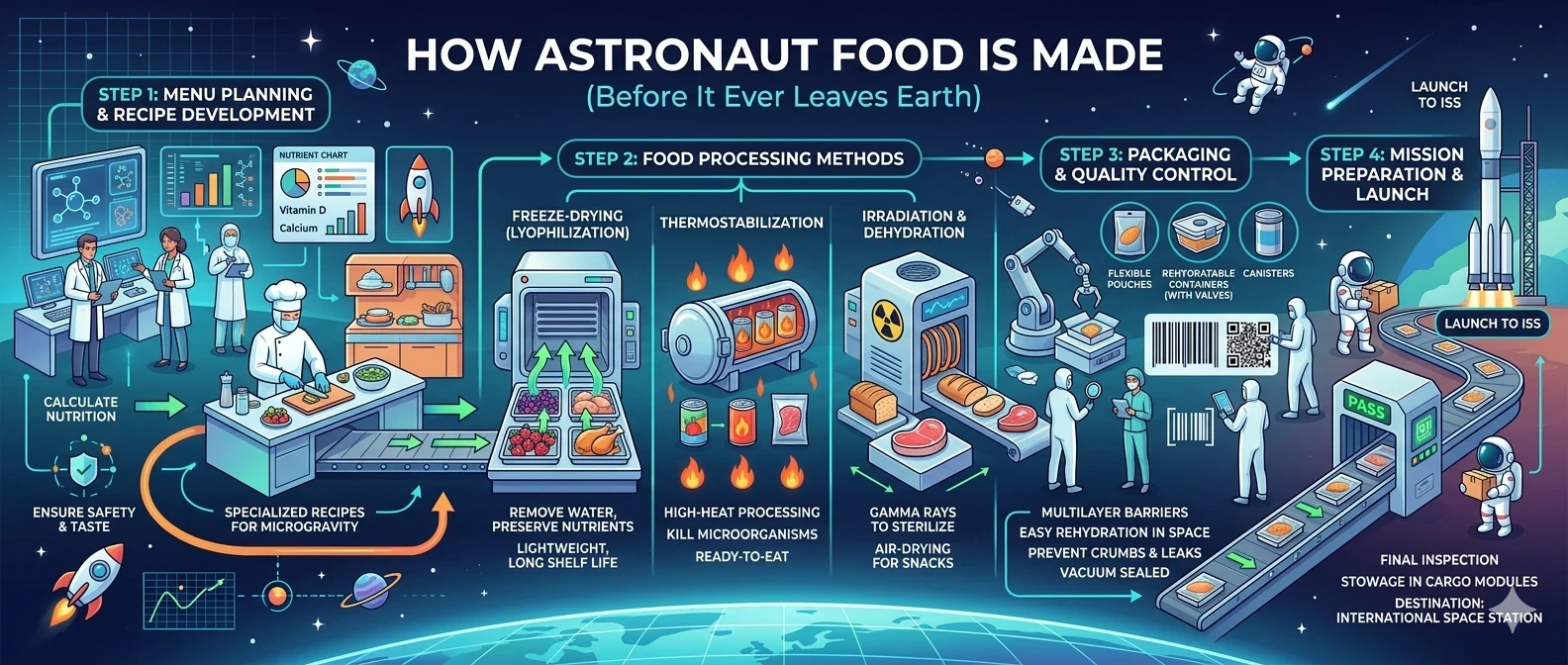
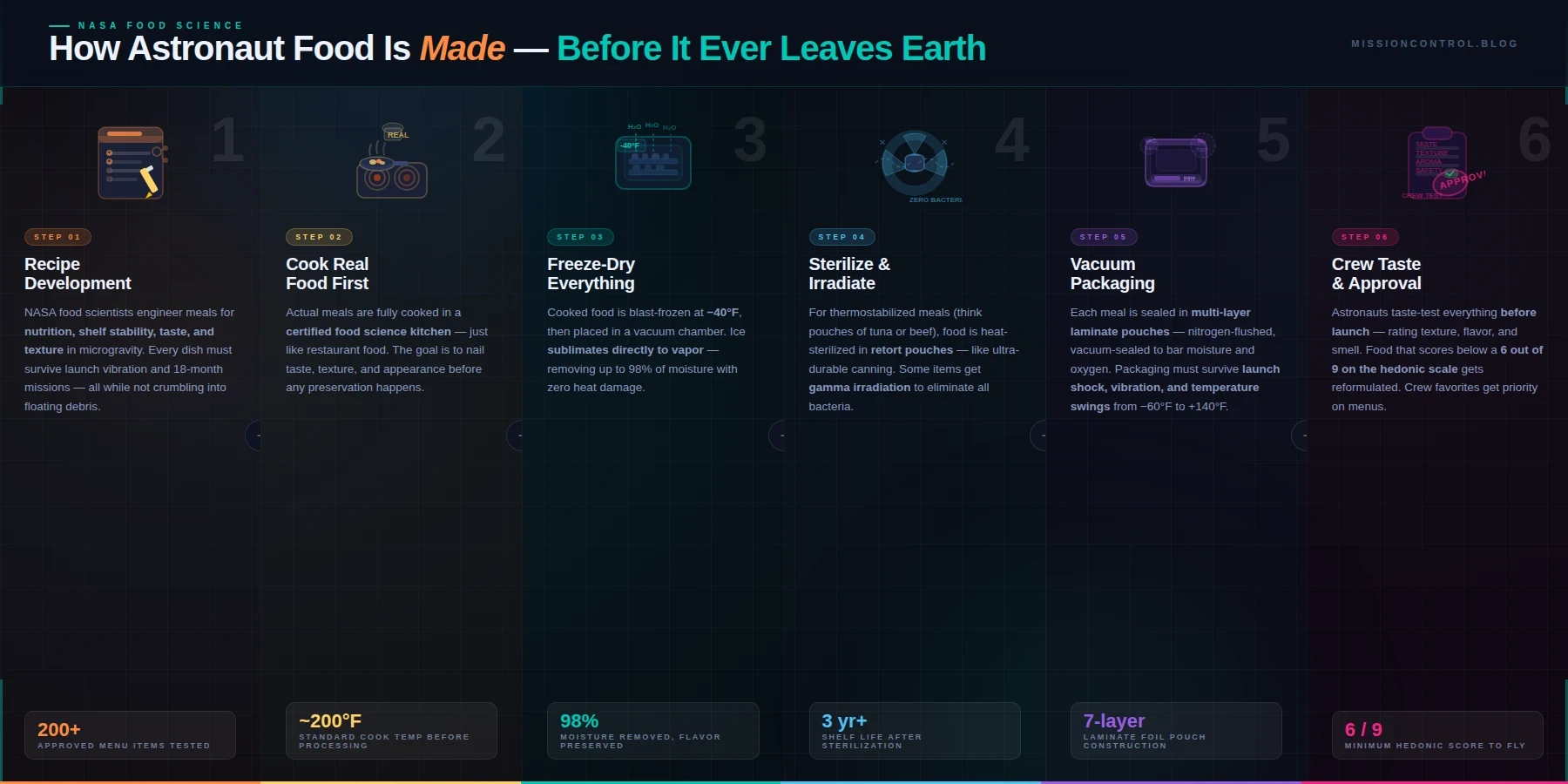
All astronaut food goes through NASA’s Space Food Systems Laboratory in Houston, Texas. It’s kind of like Willy Wonka’s factory if it was obsessed with shelf life and sanitation instead of chocolate rivers.
Step 1: Pick the meals
Astronauts can make requests before their mission — yes, they actually help design the menu! Each dish must meet nutritional standards (right ratios of fat, protein, vitamins, etc.) and survive long-term storage.
Step 2: Preserve it
Depending on the dish, NASA uses methods like:
- Freeze drying: Food is frozen, then water is removed through sublimation — going straight from ice to vapor. It keeps the nutrients and flavor but makes everything light and dry. To eat it, astronauts just add water.
- Vacuum sealing: Keeps oxygen out, which stops bacteria and mold.
- Radiation sterilization: For certain items, NASA literally zaps the food to kill microorganisms. (We promise your chicken doesn’t glow afterward.)
- Thermostabilization: High-heat treatment that makes food shelf-stable, like canned goods but in flexible pouches.
Step 3: Package it like space treasure
Each item is labeled, barcoded, and sealed in portion sizes — no family-style dinners in orbit. The packages are lightweight, resealable, and color-coded by meal.
Fun fact: Astronauts have to train to eat their space food on Earth, so they know how to handle all the gadgets — and how not to accidentally launch peas across the cabin.
4. How Do Astronauts Actually Eat in Space?
Eating in microgravity is an entire operation. Imagine trying to eat cereal while floating. You can’t set your spoon down, your milk floats, and if you sneeze… well, you’ll have Cheerios orbiting your face.
So how do they manage it?
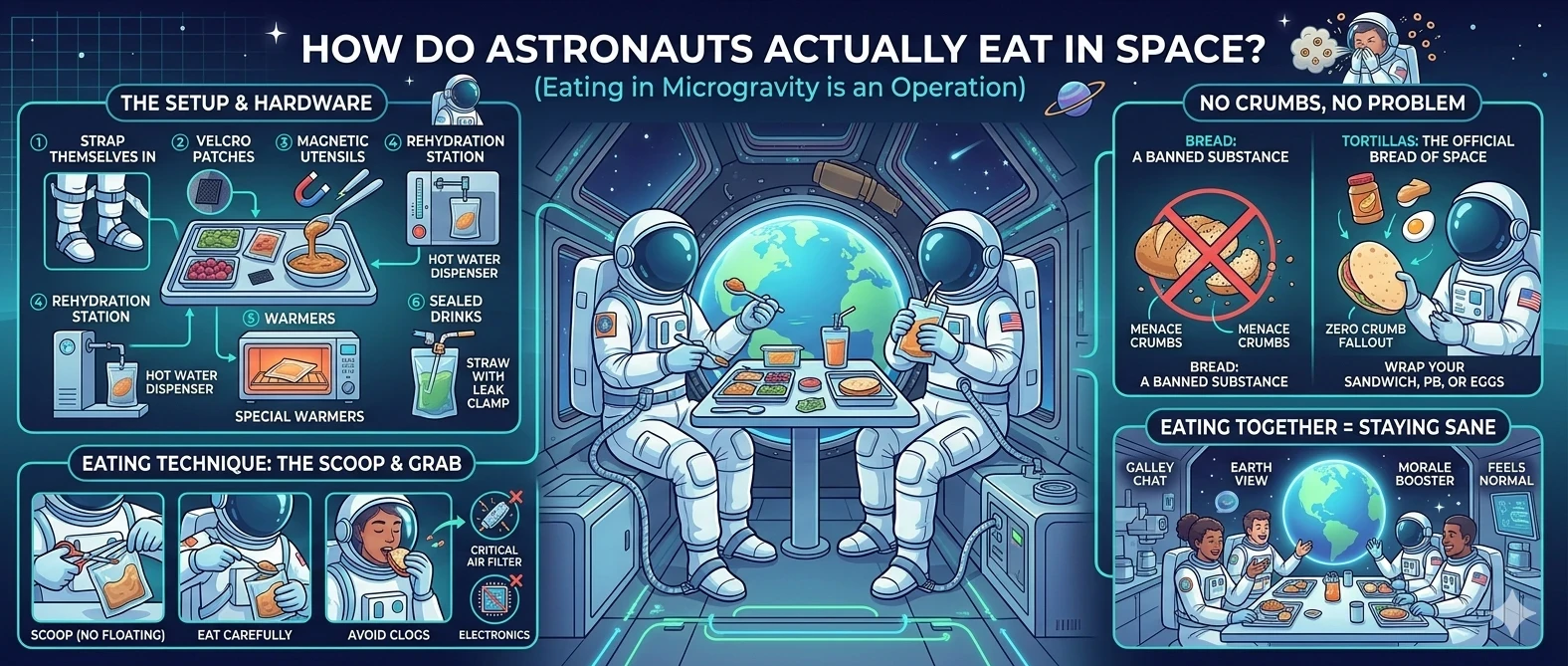
The setup:
- Astronauts strap themselves to the galley table (basically a high-tech dinner tray).
- They stick food to Velcro patches or use magnetic utensils so stuff doesn’t fly away.
- Hot water dispensers rehydrate freeze-dried foods; special warmers heat pouch meals.
- Beverages come in sealed pouches with straws that have clamps to prevent leaks.
When it’s go-time, they cut open a pouch, “spoon” (really more like scoop) the contents out, and eat carefully. If something floats off, it’s not just gross — it can clog air filters or electronics.
No crumbs, no problem
Bread is a banned substance in orbit. Those tiny crumbs? Absolute menaces. That’s why tortillas are the official bread of space. You can wrap your sandwich, your peanut butter, or even your breakfast eggs in it — all with zero crumb fallout.
Eating together = staying sane
Even 250 miles up, humans like a good dinner hangout. Astronauts often eat their meals together in the ISS’s galley, chatting and looking out the famous Earth-view window. Mealtime is a huge morale booster — the one time each day that actually feels normal.
5. Can Astronauts Cook in Space?
Ah, the million-dollar question. Can they cook?
Technically… yes, in the most NASA kind of way.
Astronauts can heat food using special food warmers — these are like tiny, controlled-temperature ovens with no open flames (fire in a spaceship = bad idea). They slide pouches in, heat them up, and then enjoy.
But “cooking” — as in cracking eggs, sautéing onions, or flipping pancakes — is trickier. Because without gravity, nothing behaves as expected. Butter won’t sit in a pan. Oil floats away. Steam doesn’t rise; it just forms a weird bubble.
Still, astronauts (and scientists) are pushing boundaries.
Epic examples:
- The Space Cookie Experiment (2019): Astronauts aboard the ISS baked the first-ever batch of cookies in a zero-gravity oven using raw dough. It took two hours to bake one cookie. So, not exactly a quick snack, but still: space history!
- 3D-Printed Food: NASA’s working on food “printers” that combine edible ingredients layer by layer. The dream? Printing pizza or pasta mid-mission with custom nutrition.
- Space farming: Astronauts have successfully grown lettuce, radishes, and chili peppers on the ISS. Small steps toward sustainable meals on Mars.
So while you’re out here air-frying your leftovers, astronauts are literally inventing new ways to eat from scratch in space.
6. What Does Space Food Taste Like, Anyway?
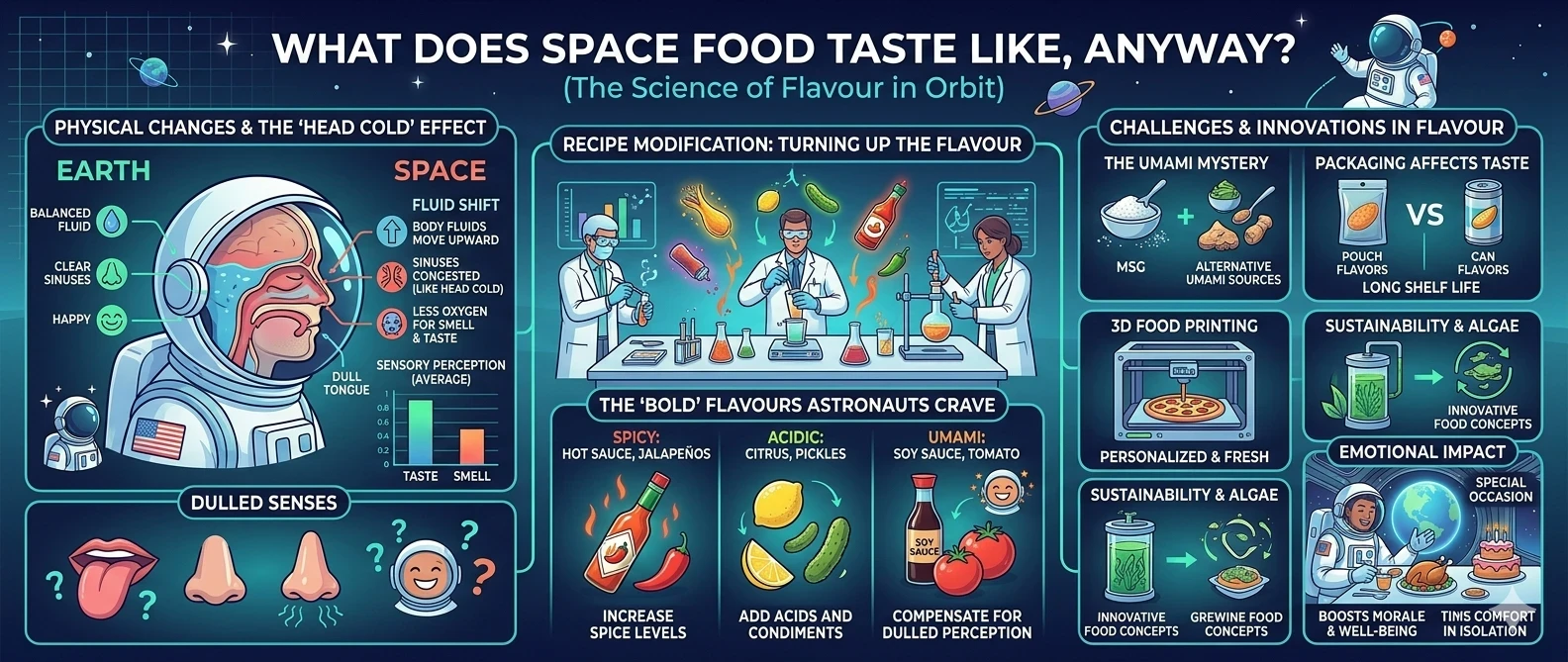
You might imagine space food tastes like cardboard — but it’s actually pretty decent. The bigger problem? Your taste buds stop working properly in microgravity.
That’s because gravity affects blood flow. In space, body fluids shift upward, making astronauts’ faces a bit puffy — like a permanent head cold. Congested sinuses = dulled taste and smell.
The fix:
Spicy food. Lots of it.
NASA’s hottest menu item has always been shrimp cocktail, but not because it’s fancy — it’s drenched in hot sauce and horseradish, which cuts through that space stuffiness.
Astronauts often add hot sauce, mustard, or jalapeño paste to boost flavor. (One even brought his own bottle of Tabasco.)
And according to most astronauts, the food tastes better than expected — more like camping meals than baby food. Some favorites include:
- Macaroni and cheese
- Beef stroganoff
- Peanut butter tortillas
- Cheesecake bites
- Thai-style curry pouches
Of course, no Michelin stars yet — but definitely an improvement from the early space days of pureed peas in a toothpaste tube.
7. How Did Astronaut Food Start (A Brief Bite of History)
Let’s rewind to the 1960s — the Space Race was on, and NASA was figuring out how to keep astronauts alive above Earth… with food paste.
Early experiments:
- Mercury missions (1961–63): Astronauts basically squeezed applesauce-like goop from aluminum tubes. Not fun.
- The most famous meal in space history wasn’t NASA-approved. In 1965, astronaut John Young smuggled a corned beef sandwich onto Gemini 3 in his spacesuit pocket. When he pulled it out and took a bite, the sandwich immediately began to disintegrate. Rye bread crumbs started floating around the cabin like tiny, rye-flavored missiles, threatening to jam the electrical panels. It caused a minor scandal in Congress, and NASA basically had to pinky-promise that no one would ever bring unauthorized deli meats into the void again.
- Gemini missions (1965–66): NASA introduced freeze-dried food — tastier, lighter, and a little more humane.
- Apollo missions (1969–72): Actual utensils! Astronauts dining on “space spaghetti” and “beef stew” could almost pretend they were on Earth.
- Space Shuttle era (1981–2011): Bigger crew, more options. Fresh fruit, tortellini, and even desserts made it on board.
By the time we got to the ISS, NASA had perfected the art of making food that tastes good and plays nicely with gravity.
8. Fun (and Weird) Space Food Facts
You know we couldn’t resist a snack-sized trivia section.
- Tang wasn’t invented by NASA. The space program just made it famous when John Glenn drank it in orbit.
- No carbonated drinks allowed. Because carbonation doesn’t separate in zero gravity — it’s just liquid foam. “Burping” in space can be… messy business.
- Space pizza exists. Yes, astronauts have made mini pizzas using tortillas, tomato paste, and cheese. It’s basically a snack wrap masquerading as dinner, but we respect the effort.
- Astronauts can bring “bonus food.” Each astronaut gets a small personal stash — often comfort food or cultural favorites. (Japanese astronauts love miso soup; Italians bring espresso.)
- Space smells weird. After heating, food releases scents that linger in the cabin. One astronaut described it as “a mix between a metallic BBQ and a car workshop.” Appetite not guaranteed.
- Ever wonder why astronauts obsess over Sriracha and Tabasco? When you go to space, your bodily fluids shift toward your head because there’s no gravity to pull them down. This causes “puffy face,” which feels like having a permanent head cold. Your nasal passages get stuffed up, and your sense of taste practically disappears. To feel anything at all, astronauts need HEATED flavors. The Artemis II crew is currently packing five types of hot sauce, including: Sriracha (The classic), Cholula (The fan favorite), Frank’s RedHot (For that “I put that on everything” vibe)
- You will almost never see sliced bread on the International Space Station (ISS) or the Artemis missions. Why? Space crumbs are public enemies. There’s actual footage of bread being banned from the Apollo missions after one rogue crumb caused near-chaos. Tortillas forever. They don’t crumble, they last for months, and they double as a plate. You can put anything on a space tortilla: peanut butter, scrambled eggs, or even the new Artemis BBQ beef brisket.
9. Can Astronauts Have Coffee (Without Spilling It)?
Bless NASA — they figured this one out early.
Astronauts drink coffee from sealed pouches using special straws. But in 2015, scientists designed the zero-gravity coffee cup — a weird-looking container that lets liquids cling to its surface through capillary action, so astronauts can sip like normal humans.
Fun fact: Italian astronaut Samantha Cristoforetti was the first person to drink an authentic espresso in space. She even wore a Star Trek uniform for the occasion. Legend.
10. The Weirdest Items on the 2026 Menu
The Artemis II mission has a whopping 189 unique menu items. We’ve come a long way from liver paste. Some highlights include:
- Floating Coffee Orbs: You don’t drink coffee from a mug; you sip it from a pouch or “catch” floating balls of caffeine.
- Maple Cream Cookies: A special request from Canadian astronaut Jeremy Hansen (because you can take the man out of Canada, but you can’t take the maple out of the man).
- Liquid Salt and Pepper: You can’t shake flakes in space! Salt is dissolved in water and pepper is suspended in oil so you can “squirt” your seasoning.
- Recycled… Water: Let’s be real—the water they use to rehydrate that Mac & Cheese? It used to be yesterday’s sweat and urine. As the saying goes on the ISS: “Today’s coffee is tomorrow’s coffee.”
If humanity’s going to live on Mars or build space colonies, we can’t just keep shipping mac and cheese pouches from Houston.
11. The Future of Space Dining: Mars Menus & Beyond
The challenges:
- Resupply missions take months (and millions of dollars).
- Long missions mean food must last years without losing nutrients.
- Variety is key to mental health — eating the same five meals for 600 days is no small test.
The innovations:
- Space farming: Astronauts have already grown lettuce and chili peppers on the ISS — the first true “space-to-table” meals. Future missions could see mini greenhouses for fresh veggies.
- Algae and protein alternatives: Algae grows fast, recycles CO₂, and packs nutrients. Think of it as the kale smoothie of outer space.
- 3D-printed nutrition: Imagine a food printer that uses stored powders and oils to make burgers, chocolate, or pasta on demand. Personalized macros for every astronaut.
- Community cooking: Some NASA experiments hint at social “kitchen modules” where astronauts can prepare and share meals together — not just packets, but real cooking rituals to support mental balance.
So, when we finally step on Mars, it’s possible our first meal there won’t be a pouch of rehydrated stew but a hand-grown salad and a freshly printed pizza.
We’ve come a long way from applesauce tubes.
12. Eating Like an Astronaut (on Earth and on a Budget)
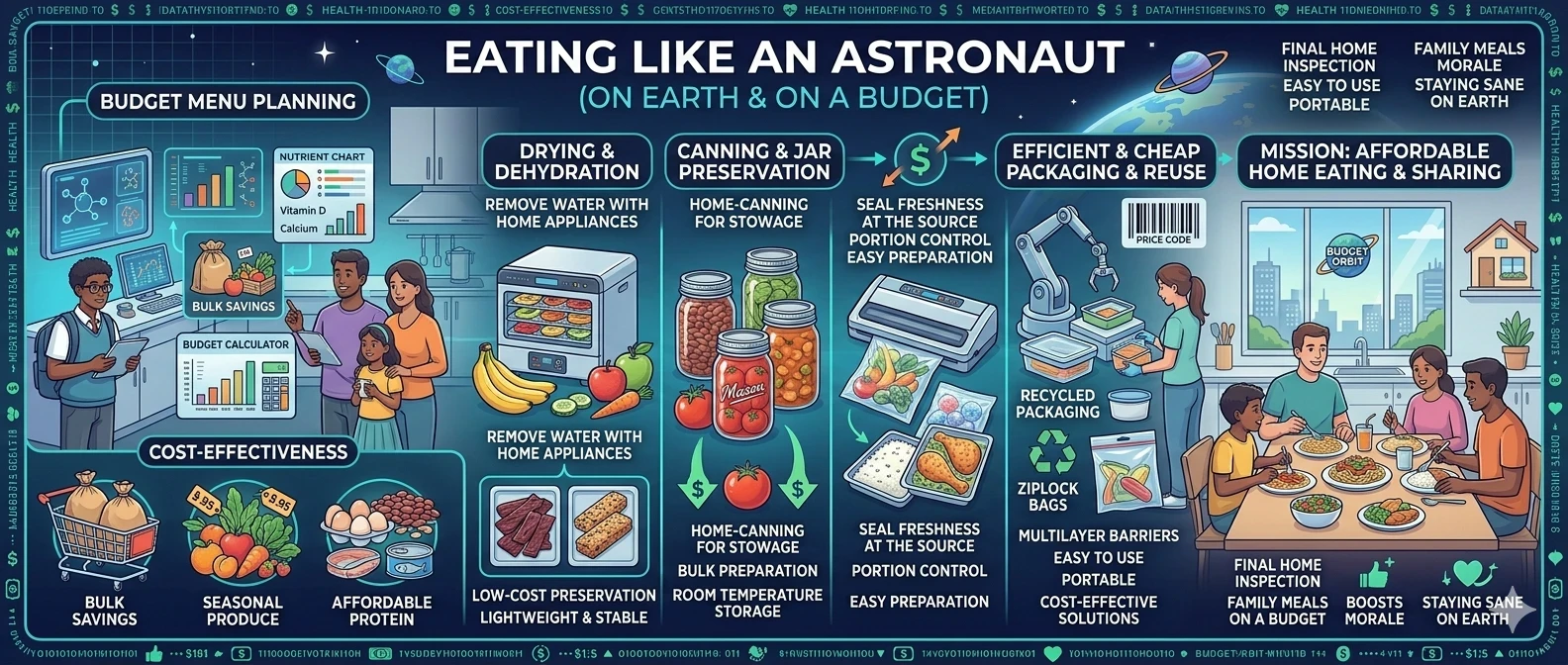
If you’re curious to try “space food” yourself, you don’t have to hitch a ride on a rocket. You can:
- Buy astronaut meals: NASA-approved freeze-dried snacks (like ice cream or strawberries) are sold online — they’re surprisingly good, although expensive for the portion size.
- DIY it: You can mimic the idea at home with your dehydrator or by making jar meals for hikes.
- Or just adopt the philosophy: high nutrition, low waste, long shelf life. Honestly, it’s the ultimate budget bite.
NASA’s obsession with efficiency lines up surprisingly well with being budget-friendly — plan your meals, reduce waste, and make the most out of shelf staples. Turns out, you and astronauts have the same goals: eat smart, save money, and stay alive (preferably not floating).
12. The Big Takeaway: Space Food Is About Humanity, Not Just Survival
It’s easy to laugh at the idea of vacuum-packed lasagna and floating coffee bags, but food in space isn’t just a technical necessity — it’s a deeply human need.
Sharing meals, tasting flavors, and enjoying comfort food remind astronauts of home — something grounding (well, figuratively) when everything else is weightless.
And every advance they make up there — from 3D-printed meals to growing lettuce in orbit — could reshape how we feed people down here, especially in environments with limited resources.
So next time you microwave leftovers, think of the astronauts doing the same… just with slightly more floating.
FAQs About Astronaut Food
Can astronauts eat pizza?
Yes! They make mini tortilla “pizzas” with tomato paste and cheese. It’s not delivery — it’s orbit.
Can they drink alcohol in space?
No alcohol allowed. NASA banned it because it affects coordination, sleep, and spacecraft systems. (Also, no one wants space hangovers.)
Why can’t they eat bread?
Crumbs float and can clog equipment or eyes. Tortillas are the safer sandwich hero.
Can they reheat leftovers?
Technically everything is single-portion, but reheating pouches is possible. There are no space microwaves — only warmers.
What happens if they spill food?
They grab a napkin quickly… or chase it midair with a spoon. Everything is cleanup-on-sight in zero G.
Final Bite
Space food started as paste squeezed from tubes, evolved into shrink-wrapped feasts, and is now inspiring futuristic food tech back on Earth. The challenges remain the same: keep it contained, keep it spicy, and for the love of NASA, keep the bread out of the cockpit.
It may not be glamorous, but it’s brilliant — a perfect mix of science, survival, and humanity. And maybe, just maybe, your next kitchen gadget will have a little NASA DNA in it.
So whether you’re a budget-conscious meal planner or a daydreaming foodie, just think: even astronauts need a good bite — they just have to catch it first. Next time you’re complaining about your lunch, just remember: at least you don’t have to chase your peas across the room with a Velcro-covered spoon.