
In the wide world of weight loss, it’s easy to get lost and overloaded with trendy diets and quick‑fix promises. But behind every successful weight loss plan lies one, universal rule: weight loss will occur when there is an overall calorie deficit. Regardless of which diet you choose, the underlying science doesn’t change — your body must burn more calories than it consumes in order to lose weight.
Once you understand that, everything else starts to make sense. You don’t need to overcomplicate it or go back and forth between different diets. Creating a calorie deficit in a healthy, manageable way is what truly makes the difference.
A calorie deficit expresses the essential truth of weight loss, occurring when a person consumes fewer calories than their body burns through daily metabolic processes and physical activity. Rather than relying on detailed, complicated diets, this approach focuses on the energy/balance equation, where the body taps into stored fat for fuel once glycogen levels are depleted. To achieve approachable and genuine results without compromising muscle mass or metabolic health, experts recommend an overall daily deficit of no more than 500 to 750 calories. Determining this number involves determining one’s Total Daily Energy Expenditure (TDEE) by multiplying the Basal Metabolic Rate (BMR) by an activity factor. Calculator.
Success involves practical strategies like swapping calorie-dense foods for high-protein, fiber-rich alternatives and increasing movement through simple activities like walking. However, it is crucial to avoid overly aggressive restrictions that can trigger persistent fatigue, hormonal disruptions, or muscle loss. Consistency will always be more valuable than intensity, as small, repeatable habits allow the body to adapt gradually. By focusing on accurate tracking and nutrient-dense choices, individuals can effectively manage their weight while maintaining the energy for a healthy, active, satisfying lifestyle.
What Exactly Is a Calorie Deficit?
If you’ve ever tried to lose weight, you’ve probably run into the term “calorie deficit.” It gets tossed around constantly in fitness circles, diet plans, and nutrition articles, but what does it actually mean in practice? At its core, understanding what it is gives you the single most important piece of the weight loss puzzle.
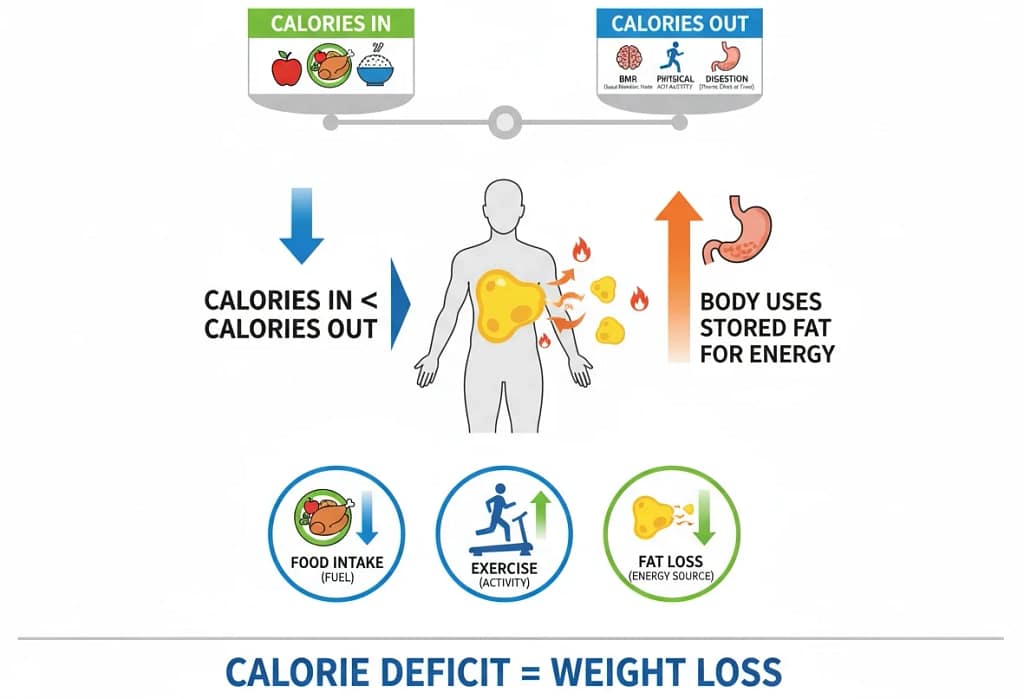
A calorie deficit happens when you consume fewer calories than your body burns. That’s it. No magic pills, no extreme restrictions, just a straightforward energy equation. But while the concept is simple, applying it correctly and appropriately matters more than most people realize. Get it wrong, and you risk muscle loss, nutrient gaps, or a metabolism that fights back hard.

Why a calorie deficit matters for weight loss
Your body runs on energy, and that energy comes from the food you eat. Every biological process, from breathing to building muscle, requires calories to function. When you understand the concept of a calorie deficit and how it connects to weight loss, you stop guessing and start making decisions based on how your body actually works.
The energy balance principle
Weight loss or gain comes down to one main principle: energy balance. When you eat more calories than you burn, your body stores the excess as fat. When you eat fewer calories than you burn, your body has to pull energy from somewhere, and that somewhere is primarily stored body fat. This is why a calorie deficit forms the foundation of virtually every effective weight loss approach, regardless of whether it’s low-carb, high-protein, or anything else.
The reason this matters so much is that no other factor can override the total energy calculation. You can eat the cleanest diet available, but if you consistently consume more calories than you burn, your weight will not decrease. Research from sources like the National Institutes of Health and National Health Service (NHS, UK) consistently show that total calorie intake is the main driver of weight loss outcomes.
Why the size of your deficit matters
Not every deficit is equally effective or safe. A deficit that’s too small may produce results so slow that you abandon your plan before seeing meaningful progress. A deficit that’s too excessive, however, can trigger muscle loss, crash your energy levels, and cause your metabolism to slow as your body shifts into survival mode. Centers for Disease Control and Prevention (CDC)
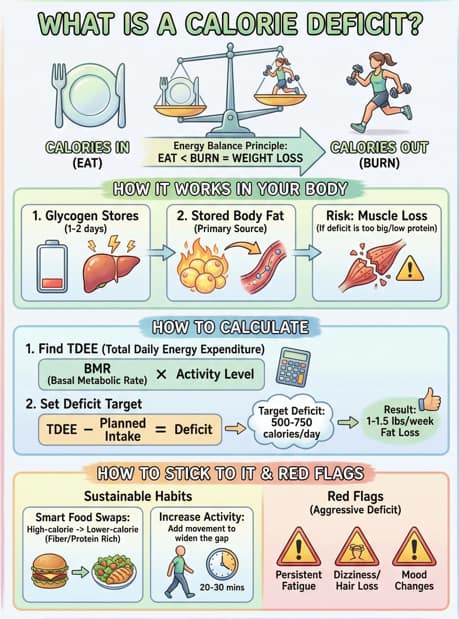
Research points to a moderate deficit of 500 to 750 calories per day as the rational and effective sweet spot for most people. This typically delivers around 1 to 1.5 pounds of fat loss per week, which is a pace sustainable enough to preserve muscle mass and keep your energy stable. Going well beyond this threshold without medical supervision raises the risk of nutritional deficiencies and hormonal disruptions that work against your long-term progress.
The goal isn’t the biggest deficit that you can tolerate. It’s one you can continuously maintain while still eating enough to feel good, remain active, and give your body the nutrients it actually needs.
How a calorie deficit works in your body
When you understand what exactly a calorie deficit is, the next question is: what is actually happening inside your body when you eat less than you burn? Your body follows a specific sequence of metabolic responses, and knowing that sequence helps you set realistic expectations for how quickly and sustainably fat loss actually occurs.
Your body’s fuel hierarchy
The body prefers to use readily available energy before tapping into stored reserves. As soon as your calorie intake drops below what you burn, your body begins pulling from glycogen, the stored form of carbohydrates held in your liver and muscles. These glycogen stores are limited by design, and they typically deplete within a day or two of consistent deficit eating.
Once glycogen runs low, the body shifts its primary energy source to stored body fat. Fat cells release fatty acids into the bloodstream, and the cells convert them into usable fuel through a process called beta-oxidation. This is the actual mechanism behind fat loss, and it only accelerates when you maintain your deficit consistently over days and weeks, not just a single day.
Why muscle loss is a real risk
The body can also break down muscle tissue for energy, especially when your deficit is too aggressive or your protein intake is too low. Muscle is metabolically and calorie demanding to uphold, so your body treats it as a backup fuel source when under significant caloric stress. Keeping your deficit moderate and prioritizing adequate protein intake (roughly 0.7 to 1 gram per pound of body weight) gives your body a strong signal to preserve muscle while burning through fat stores instead. Harvard
How to calculate your calorie deficit
Knowing what is a calorie deficit is only useful if you can put an actual number on it. The calculation starts with two pieces of information: how many calories your body burns each day and how many calories you currently consume. The gap between those two numbers is your deficit.
Step 1: Find your total daily energy expenditure
Total daily energy expenditure (TDEE) is the total number of calories your body burns in a 24-hour period, covering everything from basic organ function to physical activity. You calculate it by first estimating your basal metabolic rate (BMR) (Body Weight Planner), which represents the calories your body burns at rest, and then multiplying that figure by an activity level multiplier that accounts for how much you move each day. CalorieGuru


Step 2: Set your deficit target
Subtract your planned daily calorie intake from your TDEE to find your deficit. For steady, manageable fat loss, aim for a deficit between 500 and 750 calories per day. That range typically produces one to one and a half pounds of weight loss per week without pushing your body into the stress response zone that triggers muscle breakdown and metabolic slowdown.
Keep in mind that your logged calorie intake only works as a tool if it’s accurate. Tracking what you eat for at least two weeks gives you a reliable baseline to work from.
How to create a deficit you can stick to
Calculating what is a calorie deficit gets you a round number, but building habits that keep you in that deficit over weeks and months is what actually drives fat loss. A deficit you can’t sustain for more than a few days will produce no perceivable results. The ultimate goal is consistency, and that will only happen when your approach fits your real, everyday life rather than an idealized version of a meal plan. Mayo Clinic
Adjust your eating without going hungry
The most sustainable way to cut calories is to swap out higher-calorie foods for lower-calorie options that still fill your plate. Replacing refined carbs with fiber-rich vegetables, choosing lean proteins, and cutting liquid calories like soda or alcohol adds up quickly without leaving you feeling deprived. Protein specifically helps here because it digests more slowly than carbohydrates, keeping you fuller for longer on fewer total calories.
Tracking what you eat gives you a clear and honest picture of where your calories are actually coming from. Most people will underestimate their portions without even realizing it, sometimes by several hundred calories a day. Spending two weeks logging your meals with reasonable accuracy helps you find patterns and allows you to make targeted, actual adjustments rather than cutting everything without reason.
Use activity to widen the gap
Physical activity gives you another element to work with. Adding movement to your day, whether through structured workouts or simply walking more, increases your total daily calorie burn without forcing you to eat less food. Combining a modest reduction in food intake with consistent physical activity spreads the deficit across both sides of the energy equation, making it easier to hit your target without feeling like you are constantly restricting yourself.
Your activity level doesn’t have to be intense to count. Even adding 20 to 30 minutes of brisk walking each day burns roughly 100 to 200 extra calories depending on your body weight, which contributes meaningfully to your weekly deficit without requiring a gym or a structured program.
Risks, red flags, and when to get medical advice
Understanding what is a calorie deficit requires knowing where it can go wrong. A deficit that’s too deep or maintained without enough nutritional variety puts real stress on your body, and ignoring early warning signs can set back your progress far more than eating as normal.
Signs your deficit is too aggressive
Your body will communicate when it’s under too much strain, and the signals are typically hard to miss. Persistent fatigue that doesn’t improve with sleep, frequent dizziness, noticeable hair thinning, or loss of your menstrual cycle in women are all signs your deficit has pushed past what your body can handle safely. These aren’t minor inconveniences; they indicate your body is pulling resources from essential systems to compensate for the energy gap.
Mood changes and intense food preoccupation are also red flags. If you spend a significant portion of your day thinking about food, feeling irritable between meals, or struggling to focus, your deficit is likely too aggressive and needs to be reduced.
When to talk to a doctor
Some people should consult a healthcare provider before undergoing any kind of calorie deficit. Individuals with a history of disordered eating, diabetes, thyroid conditions, or heart disease all face added complexity when restricting calories, and a deficit that’s safe for a generally healthy person may not be appropriate for someone managing an underlying condition.
You should also seek medical advice if you’ve been in a deficit for several weeks and notice no measurable change in weight or energy levels, as this can indicate a hormonal or metabolic issue that tracking and food swaps alone won’t resolve.
Key takeaways and next step
Understanding what is a calorie deficit boils down to one simple principle: burn more calories than you eat, consistently, and your body burns stored fat to fill the gap. A moderate deficit of 500 to 750 calories per day gives you steady fat loss without pushing your body into muscle-burning, metabolism-slowing stress. You calculate it by finding your TDEE, then subtracting your planned intake from that number.
Sustainable results come from small, repeatable habits rather than aggressive cuts. Swap calorie-dense foods for filling alternatives, track your intake honestly for a few weeks, and use physical activity to widen your deficit without eating less than your body needs. Watch for red flags like persistent fatigue, dizziness, or mood swings, and adjust your deficit if those signs appear.
Ways to monitor and track Calorie Intake and Outtake.
This is a really solid, no-nonsense breakdown. I like how you cut through all the noise and brought it back to the one thing that actually drives results—energy balance.
From experience, this is where most people get tripped up. They bounce from diet to diet thinking something is “broken,” when really they were never in a consistent deficit to begin with. Once you understand that piece, everything else starts to click like you said.
I also appreciate that you addressed the risks of going too aggressive. That’s something a lot of fitness content skips over, and it’s usually why people burn out or rebound.
The emphasis on sustainability and habits is spot on too. The people I’ve seen succeed long-term aren’t the ones doing extreme cuts—they’re the ones who find something they can actually live with day to day.
Great job keeping this practical and grounded in reality.
Thanks Jason! That’s what worked best for me. I tried all the fancy and latest diets and didn’t have much success. It was when I broke it down to this simple math problem of total daily calorie count that I continue to have success with. Now I can try a different diet every day.