
Farmers Market vs Grocery Stores: Where You Actually Save Money (Real Price Comparison Guide)
Let’s be honest, most people assume farmers markets are expensive, aesthetic places you visit for fun rather than for real grocery shopping. On the surface, that makes sense. You see hand-painted chalkboard signs, artisan bread, small-batch jams, and vendors passionately explaining their farming methods. It feels more like an experience than a budget strategy. And to be Honest? Fair reaction.
You start mentally comparing it to your regular grocery store, efficient, predictable, and affordable. Bright lights, stacked shelves, weekly ads, store brands that quietly get the job done and peppers stacked into a perfect pyramid, and you feel a strange sense of loyalty to the place that never judged you for buying store‑brand everything.
So the assumption is simple:
**Farmers markets = expensive luxury food**
**Grocery stores = cheap everyday food**
But once you actually compare prices item by item, the reality becomes a lot more interesting. Some of the freshest, best‑tasting, longest‑lasting produce I’ve ever bought came from a farmers market…and cost less than the same item at a big grocery store. Some items are dramatically cheaper at grocery stores. And some depend entirely on timing, season, and how you shop.
So instead of guessing, I did a real-world comparison across multiple grocery stores and a local farmers market to see where your money actually goes.
What I found will probably change how you shop.
https://www.ams.usda.gov/local-food-directories/onfarm
https://www.localharvest.org/farmers-markets/
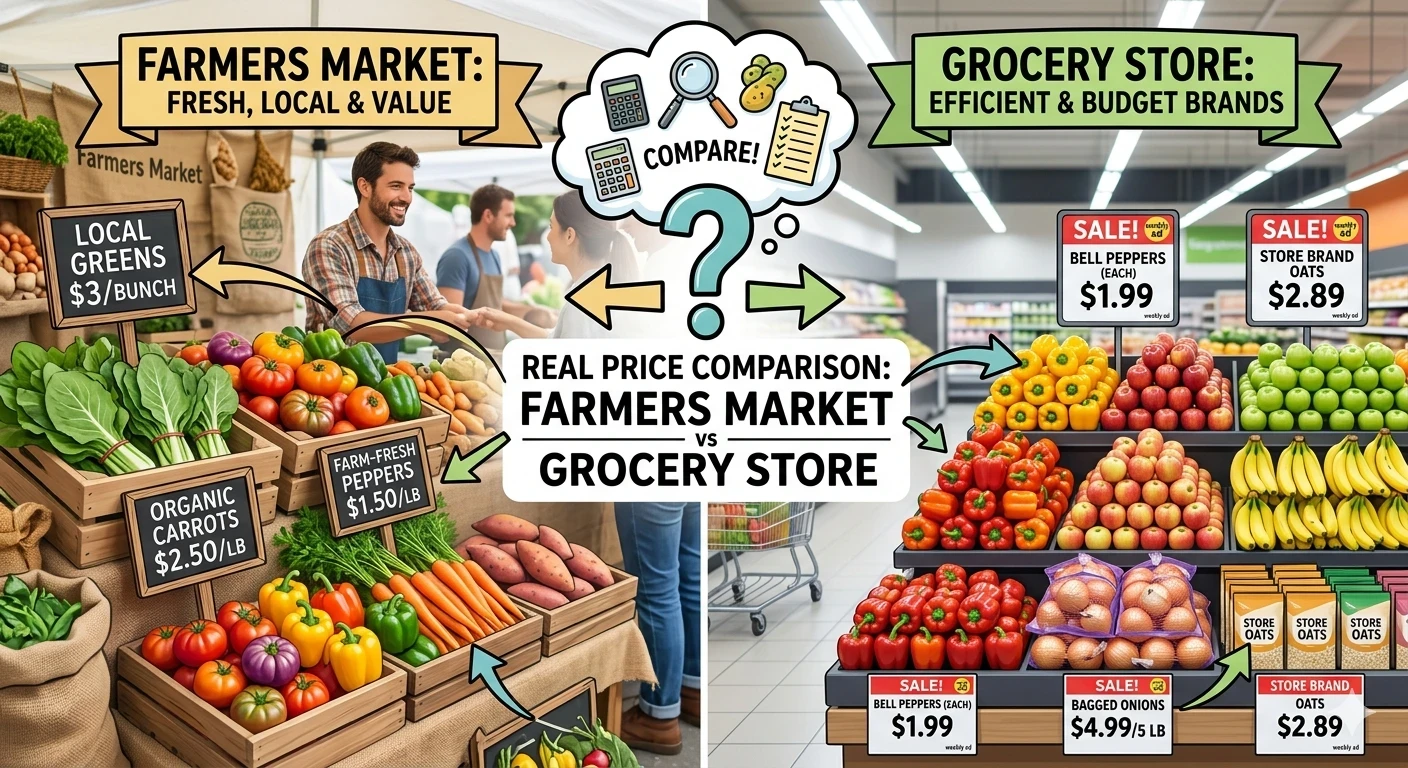
How This Comparison Works (So You Can Trust It)
I did what any budget‑obsessed, spreadsheet‑loving, food‑nerd parent would do:
- I grabbed a notebook.
- I hit my local Saturday market.
- Then I marched right on into:
### 🥕 Farmers Market:
- * Mid-size Saturday market
- * 20–30 vendors
- * Midwestern U.S. location
- * Seasonal produce focus
###🛒 Grocery Stores
- * Aldi (budget-focused chain)
- * Walmart (mass)
- * Target (general grocery section)s-market pricing baseline)
- * Kroger (standard national chain)
## # 📏 Method
- * Price per pound used whenever possible
- * Matching product types and sizes
- * Seasonal produce prioritized
- * Organic vs conventional noted when relevant
- * I asked vendors questions — which I highly recommend. Farmers love talking about their crops. It’s like asking someone about their dog.
This isn’t theoretical pricing, it’s based on what real shoppers actually pay in real stores.
⚠️ Important note: Prices will always vary slightly by region and season. A farmers market in Brooklyn, New York is going to look very different from one in rural Ohio. These numbers are meant to be a useful framework, not a precise calculator. Always check your own local prices, but this will give you a solid baseline for what to expect.
The Big Truth: It’s Not About “Cheaper vs Expensive”
Before we get into numbers, there’s one thing you need to understand:
- Farmers markets are not designed to always be cheaper.
- Grocery stores are not designed to always be cheaper either.
- They serve different pricing systems.
- Grocery stores optimize for **scale, logistics, and consistency**
- Farmers markets optimize for **freshness, seasonality, and direct sales**
- Once you understand that, the price differences actually make sense.
What People Think vs What’s Actually True
Myth #1: Farmers markets are always overpriced
Sometimes? Yes. If someone is selling $18 “ceremonial‑grade” granola, you have my full permission to walk past without making eye contact.
But right next to that stall? You might find gorgeous, in‑season zucchini for less per pound than Aldi, Walmart, or even your local grocery store — simply because the farmer grew a ton of it that week and needs to move it. When produce is in peak season, farmers often have *too much supply*, which drives prices down.
Myth #2: Grocery stores are always cheaper
This one feels true… until you look closely.
Big chains use loss leaders, those absurdly cheap rotisserie chickens or 99‑cent strawberries — to lure you in. But the rest of the cart? That’s where they make their money.
Meanwhile, produce that’s been shipped from thousands of miles away, stored in warehouses, and marked up to cover all that overhead… isn’t always the bargain it seems. They are cheaper for staples—but not always for fresh, seasonal produce.
Myth #3: Local always means expensive
Sometimes yes, but sometimes local abundance beats imported supply chain pricing. A farmer with a truckload of ripe tomatoes doesn’t need to pay for shipping, refrigeration, or middlemen. That savings can go straight to you.
The real takeaway:
The smartest strategy is not choosing one, it’s not “farmers market vs. grocery store.” It’s knowing what to buy where, and when; it’s knowing what to buy where.
Side-by-Side Price Comparison
Let’s break it down category by category.
🍅 Produce (Fruits & Vegetables)
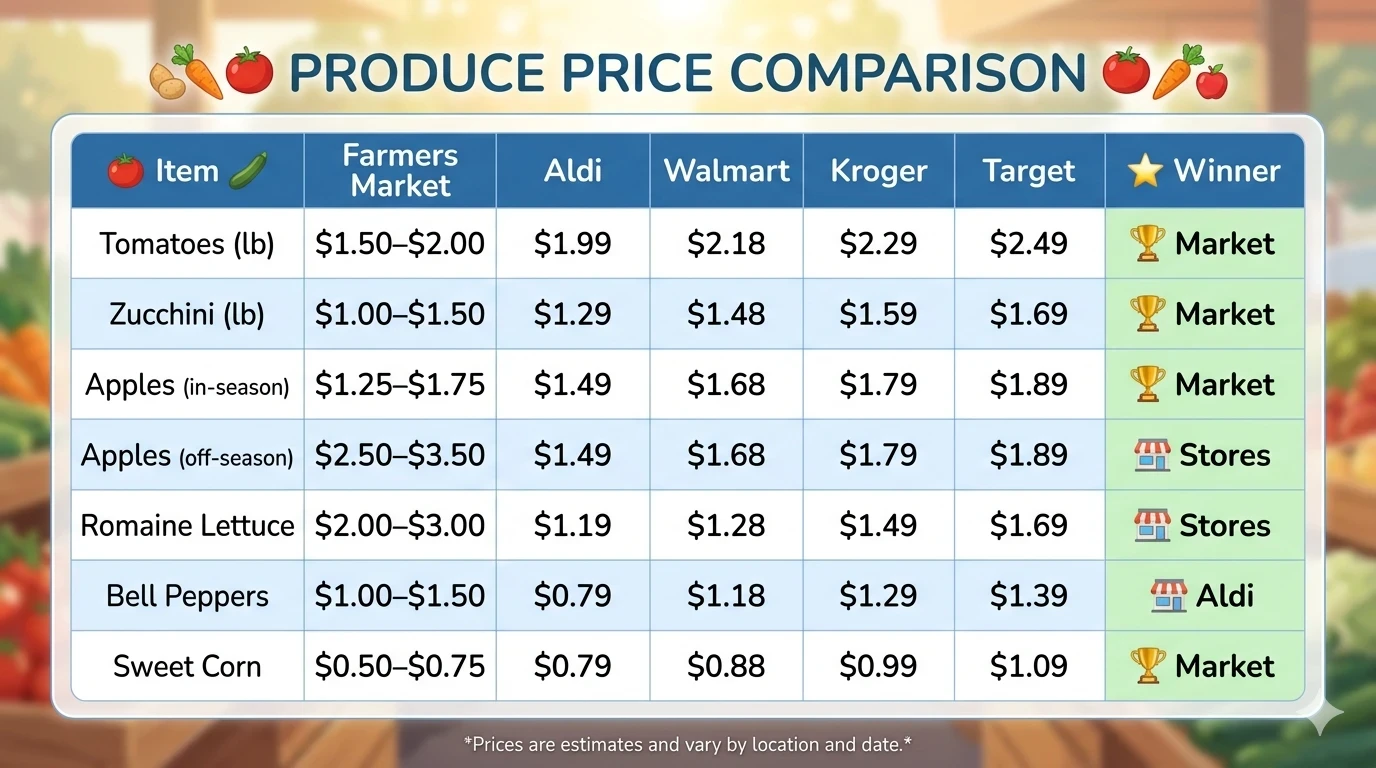
What this shows
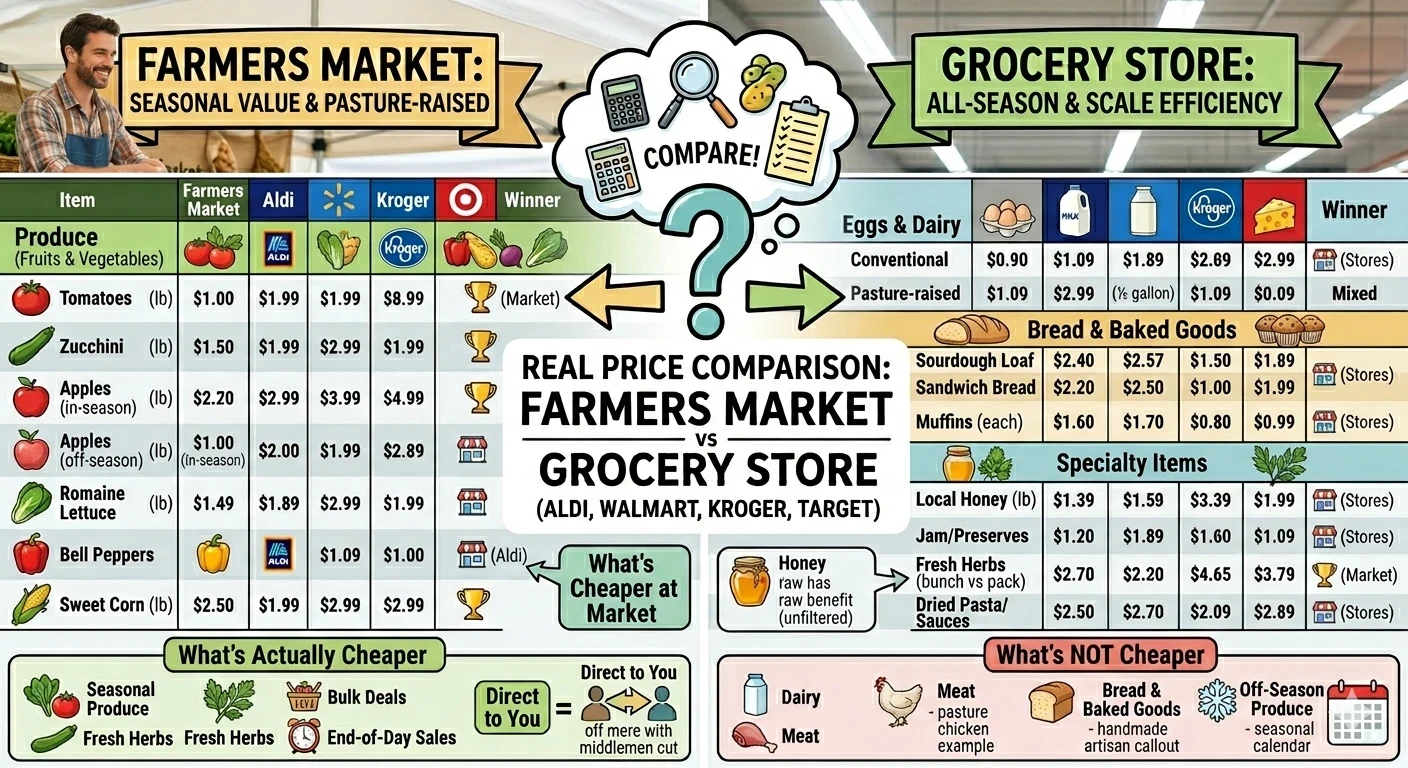
Notice the pattern? When produce is in season locally, the farmers market wins handily. The farm has an abundance, there’s no long supply chain, and they need to sell it before it spoils. When it’s out of season? The grocery store’s industrialized import machine beats them on price every time.
🥚 Eggs & Dairy
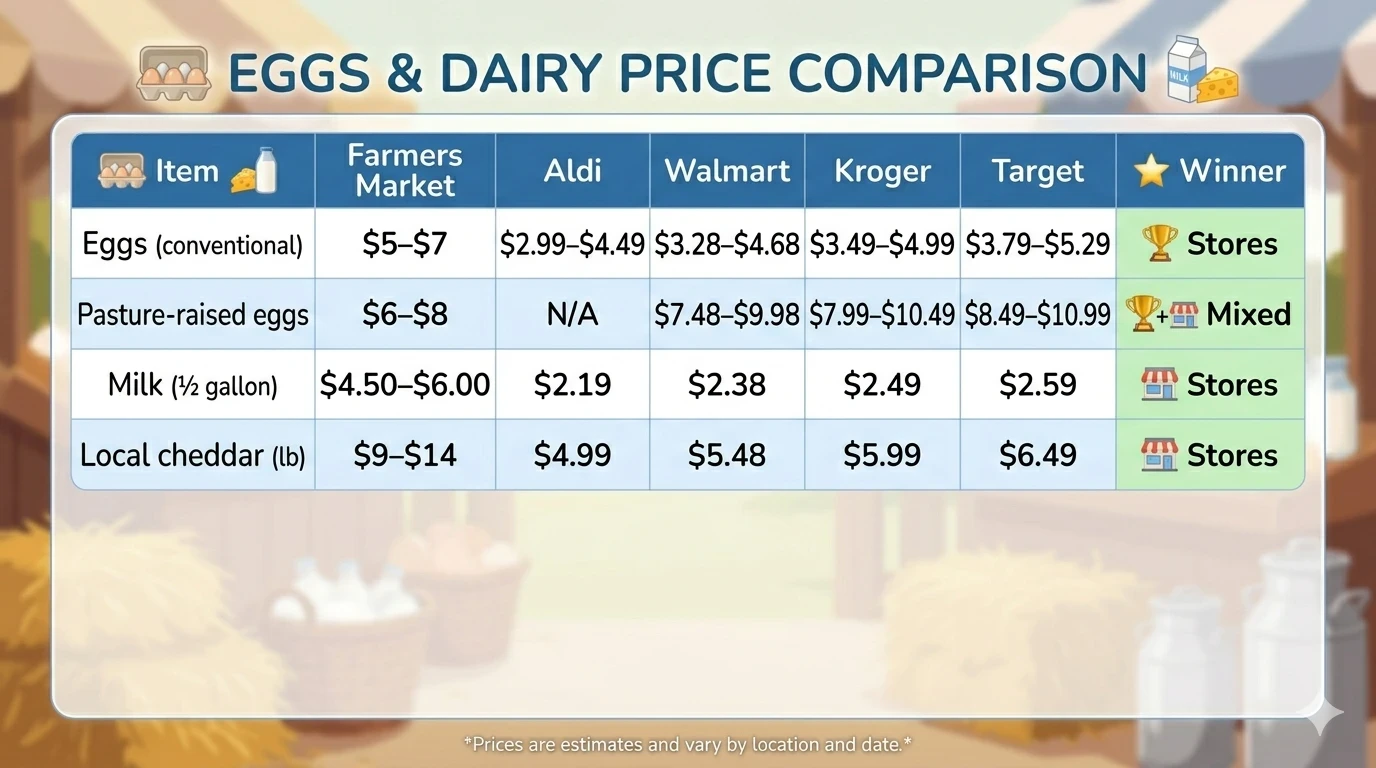
What this shows
Eggs are where a lot of people clutch their pearls at the farmers market, and to be fair, $6–$8 for a dozen eggs is a real expense. But here’s the context: those are usually pasture-raised eggs from chickens that actually see sunlight. Your grocery store’s “cage-free” label is a different thing entirely. If you’re comparing true pastured eggs to true pastured eggs? The price gap shrinks significantly. That said, if you just need eggs for scrambling on a Tuesday morning, Aldi wins this round decisively. Dairy is almost always cheaper at grocery stores due to industrial production and scale efficiency.
🍞 Bread & Baked Goods
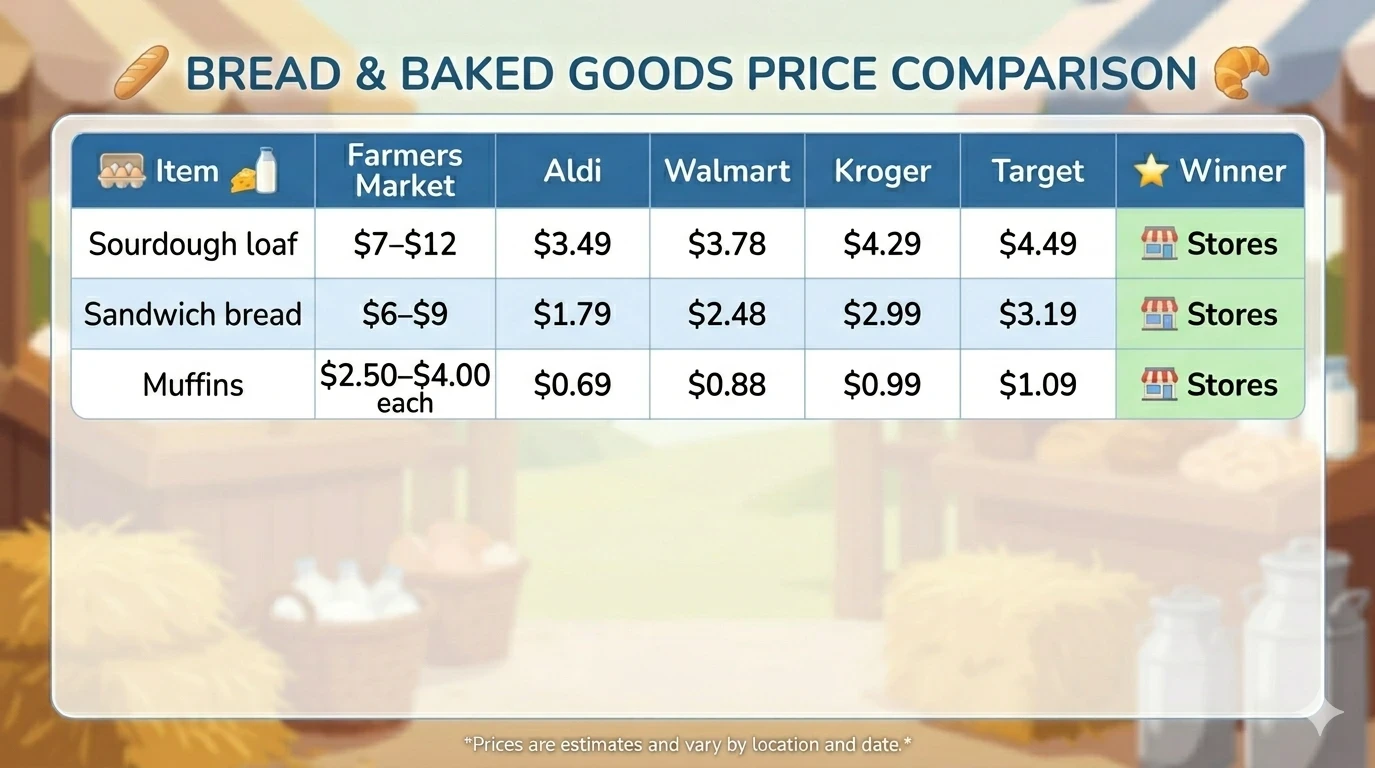
What this shows
Baked goods at farmers markets are almost always more expensive, but they’re also handmade, small batch, higher quality, and the baker woke up at 4am to make them. You’re paying for craftsmanship, not savings. If you have the budget and the taste buds, a farmers market sourdough is a beautiful thing. If you’re feeding school lunches for three kids, Aldi’s bread section is your best friend.
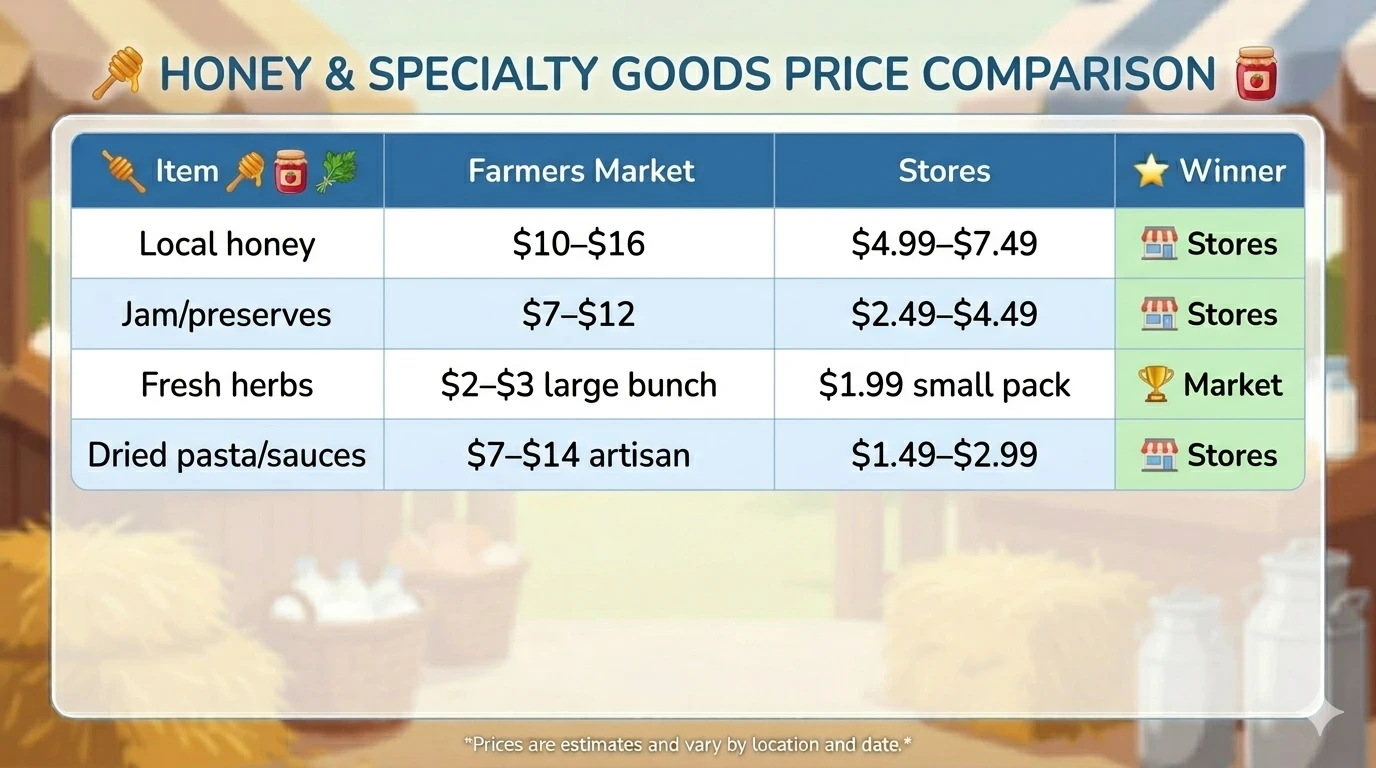
🍯 Specialty Items
What this shows
Fresh herbs are one of the best deals at farmers markets, you get 3–4× the volume. Everything else is usually cheaper at grocery stores. Honey deserves a special note: local honey actually has real benefits (raw, unfiltered, from local plants) that mass-produced store honey doesn’t offer. But if honey is just a sweetener in your morning oatmeal, the Walmart bear squeeze bottle does the job at a fraction of the price. Fresh herbs, on the other hand, are consistently a great deal at the market — you get a full lush bunch instead of the sad little grocery store clamshell that wilts before you use half of it.
What’s Actually Cheaper at Farmers Markets
Farmers markets are best at:
🌱 1. Seasonal produce: When farms are overstocked, prices drop naturally.
🌿 2. Fresh herbs: You get 3–5x more product than grocery store packs.
🧺 3. Bulk deals: Buying boxes or multiple pounds often leads to discounts.
⏰ 4. End-of-day sales: Vendors would rather discount than transport unsold food home.
The no-middleman math: When a farmer sells directly to you, they’re cutting out the distributor, the regional warehouse, and the grocery store’s profit margin. That’s potentially 2–3 middlemen removed. When supply is high, those savings get passed to you. When it’s a scarce or specialty item, the farmer can charge premium. Know which one you’re buying.
What’s NOT Cheaper at Farmers Markets
Let’s be honest about where grocery stores win.
🥛 Dairy: Milk, cheese, and butter are almost always cheaper at stores. The industrial dairy system, for all its problems, is extremely efficient at producing those items cheaply.
🍗 Meat: Small farms have higher production costs, no economies of scale. A pasture-raised chicken might run $15–$25 at a local farm stand versus $6–$10 at Walmart. The reason isn’t farmer greed — it’s genuine cost. Small-scale livestock farming is labor-intensive, slow, and expensive. There are no economies of scale. If you want to buy some local meat, consider it a treat or a planned budget item, not your weekly staple.
🍞 Bread & baked goods: Baked goods, as mentioned, are a premium experience. You’re not buying bread at the farmers market to save money. You’re buying it because it’s genuinely exceptional and you want to taste the difference. Treat it accordingly.
❄️ Off-season produce: Buying local tomatoes in January from a greenhouse farmer is going to cost you significantly more than buying imported tomatoes from Aldi. If something isn’t actually in season in your region, the “local” version isn’t going to be cheap. This is where a simple seasonal produce calendar for your region becomes a genuinely useful tool.
The Real Strategy: Use Both
The smartest grocery strategy isn’t choosing sides—it’s combining them.
The Hidden Value: What Price Tags Don’t Show
Okay, I promised to keep this grounded and not get preachy, so I’ll say this quickly and practically.
Freshness is real money. A bunch of market-fresh kale lasts 7–10 days in your fridge. A bag of grocery store kale that’s already been shipped and stored? Often 3–5. If you’re someone who buys produce and then watches half of it go bad before you use it (no judgment, we’ve all been there), fresher produce is literally reducing your food waste and stretching your budget further, even if the sticker price is slightly higher.
Taste matters for eating habits. Here’s a slightly unconventional take: food that actually tastes good makes you more likely to cook it. A genuinely good tomato makes you want to eat the tomato. If buying one or two premium ingredients makes you more likely to cook at home instead of ordering out, the math can actually work in your favor.
Transparency has practical value. Knowing your farmer means you can ask questions. Is this actually spray-free? How long has this been sitting? Can I get a discount if I come every week? You simply cannot have those conversations at Walmart. That’s not moralizing, it’s a practical information advantage.
Buy at farmers markets:
- * Seasonal fruits and vegetables
- * Fresh herbs
- * End-of-day deals
- * Bulk seasonal produce
Buy at grocery stores:
- * Dairy
- * Meat
- * Pantry staples
- * Off-season produce
- * Budget bread and basics
https://www.allrecipes.com/what-to-buy-at-the-farmers-market-11712335
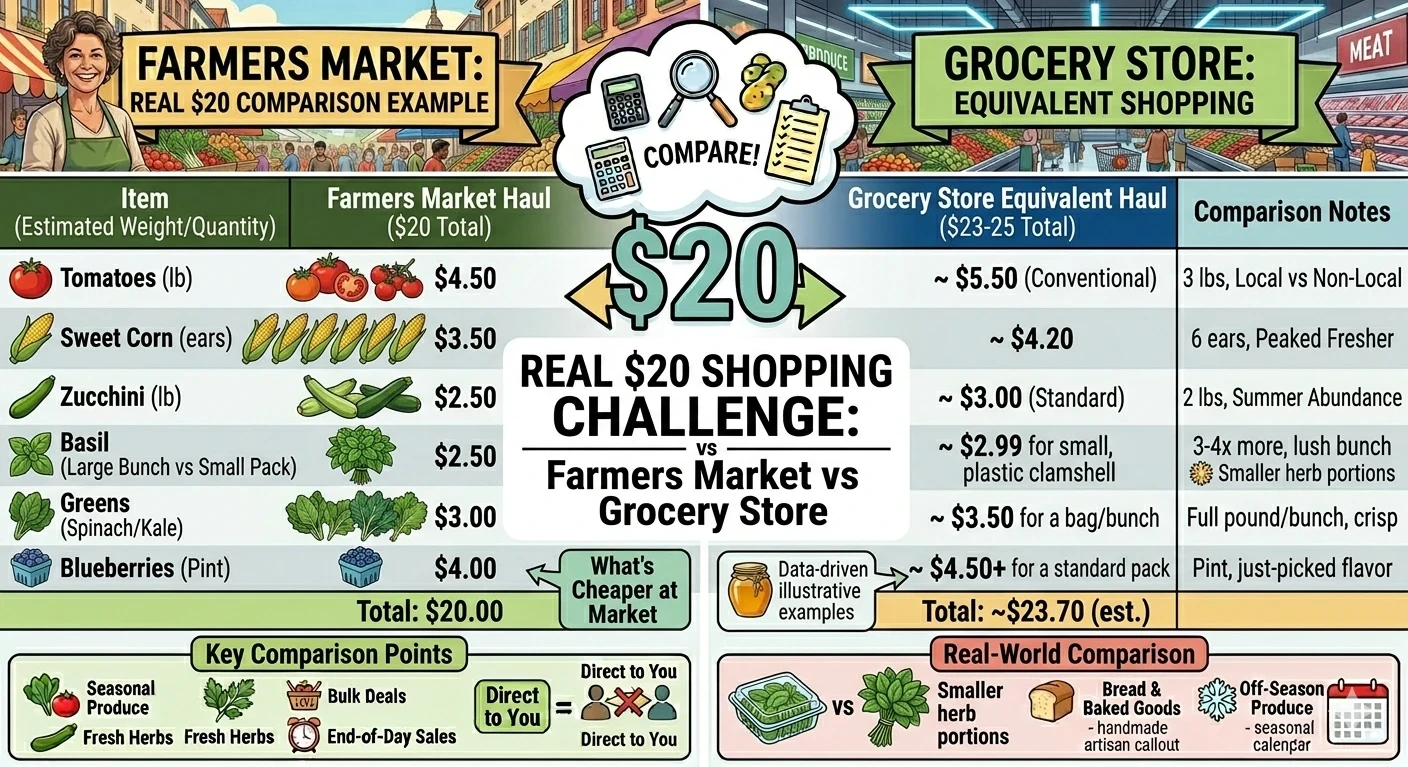
Real $20 Comparison Example
Farmers Market Haul
- * Tomatoes (3 lbs) – $4.50
- * Corn (6 ears) – $3.50
- * Zucchini (2 lbs) – $2.50
- * Basil – $2.50
- * Greens – $3.00
- * Blueberries – $4.00
- **Total: $20.00**
Grocery Store Equivalent
- * Same items: ~$23–$25
- * Smaller herb portions
- * Lower freshness
How to Actually Save Money at Farmers Markets
Strategy is everything here. Without it, you can absolutely walk out of a farmers market having spent $60 on three things and a kettle corn that you didn’t need. With it, you can get an incredible haul for $20–$30 that’s fresher than anything the grocery store has to offer. Here’s the playbook:
- 1. Show Up at the End If your market runs 8am–1pm, aim to arrive around 12:00–12:30. Vendors who drove two hours to get there are not excited about driving those two hours back with a truck full of unsold produce. That last half hour is discount city. You won’t get the best selection, but you’ll get the best prices. Great strategy if you’re flexible on exactly what you buy that week.
- 2. Bring Cash and Set a Hard Budget Markets are almost universally better with cash. Some vendors take cards now, but cash lets you negotiate easily and keeps you from accidentally spending $90 because you tapped your phone at every stall. Bring $20–$30 in small bills and when it’s gone, it’s gone. You’d be amazed how this clarifies your priorities instantly.
- 3. Walk the Whole Market Before You Buy Anything This one is huge and almost nobody does it. Do a full lap first. Compare prices between stalls — the same item can vary by 30–50% between vendors at the same market. Cherry tomatoes at stall #3 might be $4/pint; cherry tomatoes at stall #11 might be $2.50. You’ll only know if you look. It takes 10 extra minutes and is absolutely worth it.
- 4. Stick to What’s in Season This is the single most effective thing you can do. Check what’s typically in season in your region right now, and shop for those items at the market. Everything else? Get it at the grocery store. In summer, that means loading up on tomatoes, corn, zucchini, cucumbers, berries, and peaches at the market. In fall, it’s apples, squash, root vegetables. In spring, it’s greens, asparagus, and radishes.
- 5. Build a Relationship with a Vendor or Two This feels overly wholesome, I know. But there is genuine practical value here. A vendor who recognizes you is more likely to tell you what’s going to be on sale next week, offer you a deal on extra produce at the end of the day, or set something aside for you. It takes literally just saying “see you next week” and meaning it.
- 6. Buy in Bulk When the Price Is Right If you see tomatoes at $1.50/lb and you know you’ll use them — buy more than you need for one week. Roast them, make sauce, freeze them whole. A flat of blueberries for $15 sounds like a lot until you realize individual grocery store pints are $4–5 each and this is equivalent to four or five of them. Do a little math and buy ahead when seasonal abundance is on your side.
- 7. Go late: Best discounts happen in the final 30–60 minutes
$20 market strategy: $8 on whatever in-season produce looks best and is cheapest, $5 on a huge herb bunch, $4 on a specialty item (honey, jam) that you’ll use for weeks, $3 left over as buffer or for a small treat (look, one cookie from the baked goods stall is fine). That’s a well-rounded, genuinely fresh haul.
Frequently Asked Questions
Are farmers markets cheaper than grocery stores?
Sometimes, but only if you shop smart. The honest answer is that farmers markets are not uniformly cheaper or more expensive than grocery stores. They are situationally cheaper, and knowing the situations is everything. especially forr staples like dairy, meat, or bread.
What time is best to shop?
The end of the market day is when you’ll find the best discounts, as vendors want to sell remaining inventory rather than transport it home. Typically the last 30–60 minutes of any market. For the best selection, come early. For the best deals, come late.
Is farmers market food better quality?
Often fresher, but not always cheaper or certified organic.
Is organic food worth the price at a farmers market?
Not all farmers market vendors are certified organic, certification is expensive for small farms, but many use low-spray or spray-free practices without the label. Ask the vendor directly. You may find that the “no certification, but we don’t spray” produce from a local farmer is cheaper than the certified organic option at a grocery store and grown with equal (or better) care.
How much should I spend?
$20–$30 can go a long way if you shop strategically. if you plan ahead, walk the market before buying, and stick to items that are in peak season. Bring cash in small bills to keep yourself on budget and to make end-of-day negotiations easy.
How do I find farmers markets near me?
The USDA maintains a national farmers market directory at ams.usda.gov, or you can simply search “[your city] farmers market” to find local options with hours and locations. Many cities also have community Facebook groups or Instagram accounts dedicated to local market listings.
Final Verdict
Farmers markets are not universally cheaper or more expensive.
They are seasonally efficient pricing systems. If you shop strategically:
* Grocery stores win on consistency and staples
* Farmers markets win on freshness and seasonal abundance
The best strategy is not choosing one or the other—it’s using both intentionally.
You don’t just save money—you get better food for the same budget.
https://budgetbite.org/budgetfriendly-fruits-and-vegetables-in-season-apriljuly-guide/
https://budgetbite.org/eating-healthy-on-a-budget-smart-proteins-pantry-staples/
https://budgetbite.org/how-to-eat-healthy-on-a-budget-8-seasonal-recipes-april-july/

I really liked this comparison; it actually changed how I see the whole farmers market vs grocery store debate. I haven’t really shopped at farmers markets yet, but your breakdown made me realize there can be a real difference in price depending on what you buy.
I always assumed farmers markets were more expensive, but now I can see how buying in-season or at the right time could actually save money. It also seems like the quality might make it more worth it. From your experience, what would you recommend for someone going to a farmers’ market for the first time on a budget? Like, what are the best things to buy to really see the savings?
Thanks Monica! I love this time of year and seeing the farmer’s markets come back. It’s awesome to get to meet and talk with the actual growers and producers of the food I eat. Nothing better than the fresh produce right when you get home from the market.