
Eat Like You Mean It: What a Traditional Mexican Kitchen Can Teach Busy Americans

Published in honor of Cinco de Mayo, but really, this one’s for every Thursday night dinner you’ve eaten standing over the sink, illuminated by the cold glow of the refrigerator light.
Let’s all be honest for just one second. When was the last time you actually sat down for a meal? No phone, no TV in the background, no half-eaten plate abandoned because someone had soccer practice, and just… enjoyed it? With other people and without rushing?
If you’re drawing a blank, you’re in good company. The average American spends less than 30 minutes eating each meal, and 1 in 4 ate all meals alone on the previous day. We’ve turned food into fuel, something we consume as efficiently as possible so we can get back to our very important, very busy lives.
It’s the difference between fueling up and filling up. One keeps your engine running; the other keeps your soul intact. In the U.S., we treat dinner like a pit stop at the Daytona 500, fast, efficient, and over in seconds. But in a traditional Mexican household, the kitchen is the heartbeat of the home, and the table is where the real work of living happens.
While we’re inhaling a protein bar between meetings, traditional Mexican meals can stretch into hours. It’s a radical act of slow-living disguised as a dinner party.
It’s not just about the spice, although a perfectly charred poblano does help, it’s about the Sobremesa. That’s the Spanish word for the time spent lingering at the table after the food is gone, just talking. No one is looking for their keys. No one is checking their notifications. They’re just… there.
In Mexican culture, a meal isn’t just a meal. It’s an event. And this Cinco de Mayo, instead of just reaching for the nearest bag of chips and jarred salsa, maybe it’s worth asking: what are they doing that we’re not, and how do we get some of that in our own lives?
Spoiler: it’s easier than you think, It isn’t about having a five-course menu or a Pinterest-perfect table. It’s about a shift in perspective that might just change your life. Here is how to reclaim your table.

First, a Quick Reality Check on American Eating Habits
Before we dive into the inspiration, we need to name the problem. The typical American family dinner, when it actually happens, lasts barely 20 minutes. We’ve become a nation of “dashboard diners” and “desk-lunchers,” eating in our cars, at our workstations, or in the blue light of a Netflix marathon. We meal prep in solitude, eat in silence, and scroll through Instagram photos of beautiful meals we didn’t make and didn’t share.
The irony is heavy: we are more connected to “food content” than ever, yet more disconnected from the act of eating.
And the result? We’re overfed and undernourished, not just nutritionally, but socially. Research from Brigham Young University found that loneliness can be as harmful to your health as smoking 15 cigarettes a day. When we treat a meal like a solo chore rather than a social anchor, we lose a vital piece of our well-being. We’ve somehow accepted that eating quickly and distractedly is just “the way it is.”
But it doesn’t have to be.
Lesson #1: The Magic of Sobremesa (And Why You Need It)
Here’s a word that has no direct English translation: sobremesa.
Literally, it means “over the table.” But what it describes is the tradition of lingering after a meal, staying at the table to keep talking, laughing, debating, and connecting long after the plates have been cleared. In many Mexican households, sobremesa isn’t optional. It’s the whole point.
Think about the last time you had a dinner party and nobody wanted to leave the table. That warm, glowing feeling of good food and good conversation stretching into the evening, that’s sobremesa. In many Mexican households, sobremesa isn’t an optional “extra.” It’s the whole point of sitting down in the first place, just a regular old Wednesday night.
Why it matters for your health: A growing body of research shows that the social act of sharing a meal reduces cortisol (your stress hormone), increases feelings of trust and belonging, and even makes the food taste better. The Harvard Study of Adult Development, the longest-running study on human happiness in history, has followed individuals for over 80 years. Their finding? Close relationships are the single strongest predictor of a long, healthy, and happy life. Not your cholesterol levels, not your bicep peak, and not your bank account. Relationships.
When you linger, you eat slower. Research suggests that mindful, social eating can lead to better digestion and a more natural recognition of fullness cues.
How to steal this habit: You don’t need a three-hour dinner to pull this off. Try this: after your next meal with family or friends, make a rule that nobody leaves the table for 15 extra minutes. No phones, just conversation. It’ll feel awkward for about 90 seconds, and then someone will say something funny, or your kid will do something weird, and suddenly you’ll realize you’ve been sitting there for 45 minutes without noticing.
That’s sobremesa. It’s a million-dollar health hack, and it doesn’t cost a cent.
Lesson #2: Cooking Together Is a Wellness Activity (Not a Chore)
In many Mexican households, cooking isn’t a solo mission performed while the rest of the house waits for the dinner bell. It’s a communal act, a time when multiple generations crowd into the kitchen, each person with a job: one person pressing tortillas, one chopping, one stirring, one tasting and offering opinions nobody asked for. The cooking is the gathering. The party starts before the stove even gets hot.
Compare that to the “survival cooking” we see in so many homes, which often goes like this: one exhausted adult stands in the kitchen alone for 45 minutes, stress-cooking while everyone else watches TV, and then the family descends for a 12-minute meal before scattering again.
We’ve made cooking a solo performance, and then we wonder why everyone’s burned out.
Why it matters: Cooking with others has been shown to reduce anxiety, boost mood, and foster a sense of accomplishment and connection. It’s also an incredible vehicle for passing down culture, values, and stories — which is why in Mexican tradition, the kitchen is one of the most important rooms in the house. The act of making food together is an act of love.
The “We” Effect: Research on family meal preparation shows that when children and partners are involved in the process, they are more likely to appreciate the food, try new flavors, and feel a sense of belonging within the home.
How to steal this habit: Pick one meal a week, doesn’t have to be elaborate — and make it a group project. Give your kids a job (even if it’s just washing vegetables or setting the table). Call your partner over to help. Put on some music. Let it be a little chaotic. It doesn’t need to be a cooking show. It needs to be yours.
Start with something easy: guacamole. Literally every single person can participate in making guacamole. And then you can eat it together, which brings us to the next lesson.

Lesson #3: Slow Down — The Food Will Still Be There
Mexican food culture has a deep respect for the meal itself. Traditional dishes are often slow-cooked, requiring patience, a pot of pozole simmering for hours until the hominy blooms, or a complex mole involving dozens of ingredients that takes an entire day to perfect. The food doesn’t rush, and neither do the people eating it.
This stands in stark contrast to a culture that invented the drive-thru and thinks a protein bar counts as lunch.
When we eat quickly and distractedly, we miss our body’s fullness signals, which take about 20 minutes to kick in. We eat more than we need, enjoy it less than we should, and feel vaguely unsatisfied after, even when we’re technically full. Mindful eating, which researchers have linked to healthier body weight, better digestion, and reduced emotional eating, is basically just eating the way people have eaten for centuries before we decided efficiency was the highest value.
Why it matters: Slowing down at meals isn’t just nice in theory, it has measurable health outcomes. Studies show that eating slowly leads to reduced calorie intake, better digestion, and higher meal satisfaction. And the beautiful thing is that you don’t have to change what you eat, just how you eat it.
How to steal this habit: Try the “first five” rule. For the first five minutes of a meal, put your phone face down, don’t turn on the TV, and just taste your food. Notice what you’re eating. Acknowledge the work that went into it. You can return to your regularly scheduled chaos after that, but those five minutes will recalibrate your whole experience of the meal.
Bonus tip: serve food family-style, in shared dishes that people pass around the table. It naturally slows things down and creates moments of interaction (passing the salsa, offering someone more chicken) that feel small but are actually the connective tissue of family life.
Lesson #4: Food Is Identity, and That’s a Beautiful Thing
In Mexican culture, food is deeply tied to identity, pride, and belonging. Recipes are heirlooms. Regional dishes carry history. When someone makes their grandmother’s tamales for the holidays, they’re not just making food, they are keeping a lineage alive.
In 2010, UNESCO declared traditional Mexican cuisine an Intangible Cultural Heritage of Humanity. That’s a big deal. It’s a recognition that food isn’t just sustenance, it’s culture, community, and collective memory.
Many of us have drifted away from food as identity. Diet culture has trained us to see food as something to control, restrict, or feel guilty about, rather than something to celebrate, share, and pass down. The result is a complicated, anxious relationship with eating that traditional Mexican food culture simply doesn’t have room for.
Why it matters: When food is tied to identity and joy rather than guilt and optimization, people tend to have healthier, more intuitive relationships with eating. Research backs this up: people who eat traditional, culturally meaningful diets often show better health outcomes than those who follow rigid, modern diet plans.This is partly because the relationship with food is grounded in satisfaction rather than restriction..
How to steal this habit: Think about your own food heritage. What did your parents or grandparents make? What dishes make you feel like you’re home? Cook those things. Share them. Talk about where they come from. And if you didn’t grow up with that kind of food tradition, you can start building one right now, with your own family, your own recipes, your own table.
Food doesn’t have to be a source of stress. It can be a source of story.

Lesson #5: You Don’t Need a Special Occasion
Here’s the thing about Mexican food culture that might be the most radical lesson of all: the celebration isn’t reserved for special occasions. Everyday meals are treated with care. The table is set. Food is made with intention. People sit down together. The ordinary Tuesday dinner is given the same respect as the holiday feast.
We, on the other hand, tend to save the “good” experiences for special occasions, the nice dishes, the actual tablecloth, the dinner where everyone puts their phone away. We’re waiting for a reason to eat well and eat together. And in the meantime, we’re missing most of our lives.
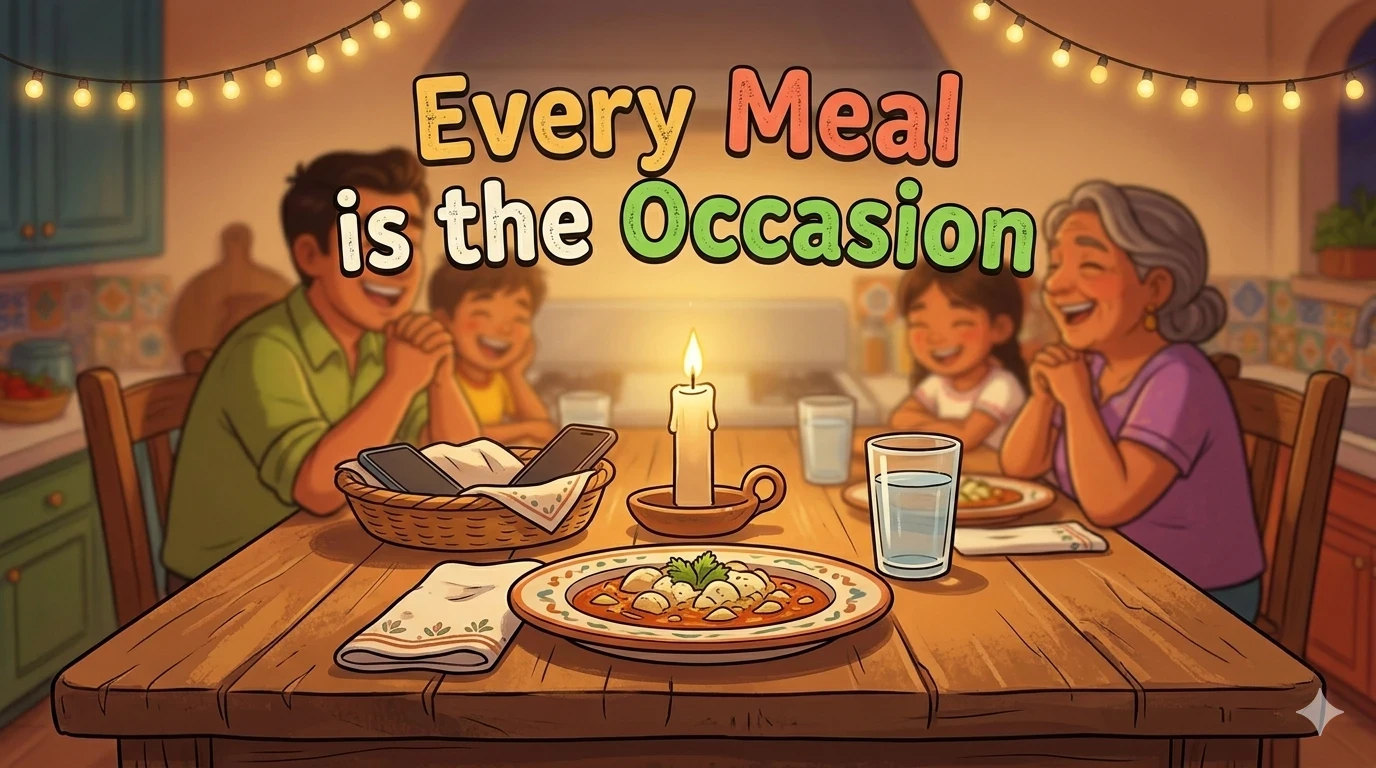
Cinco de Mayo is a great reminder. But it’s also just a date on the calendar. The real lesson is that any meal — any ordinary weeknight dinner — can be the occasion.
Your Five-Step “Eat Like You Mean It” Starter Plan
You don’t need to overhaul your life. You just need to start somewhere. Here are five small things you can do this week:
- Pick one meal and make it a phone-free zone. Just one. Work up from there.
- The Communal Chop: Cook with someone. Assign a job to your partner, your kid, or your roommate, even if their only job is “Official Drink Mixer” or “Cilantro Tearer.”
- Stay at the table 15 minutes longer than you normally would. Practice sobremesa. See what comes up.
- Make or buy a dish that connects you to a food memory. Eat it slowly and tell someone about it.
- Set the table. Even for Tuesday, Especially for Tuesday. Use the “good” napkins or light a candle. Treat your ordinary Tuesday dinner with the respect of a holiday feast.
The Bottom Line
Mexican food culture isn’t a diet. It’s a way of being, one that centers connection, slowness, joy, and togetherness at the table. And while we may not be able to replicate it exactly in our busy American lives, we can absolutely borrow its spirit.
This Cinco de Mayo, by all means, make the guacamole. Pour the margaritas. Cue up the playlist. But maybe also: put down the phone. Pull someone into the kitchen with you. Stay at the table a little longer than feels comfortable. Tell a story. Listen to one.
The food will taste better. The night will feel longer in the best way. And you might just start a tradition that outlasts the holiday.
That’s the real gift of the Mexican table. And it’s available to all of us, any night of the week.
Bonus recipes:
https://www.food.com/recipe/authentic-mexican-pozole-196233