
Why You Need Five Minutes of Doing Nothing (And Why Your Brain Is Begging You For It)
Let me guess. You woke up, checked your phone before your feet hit the floor, made coffee while scrolling, ate breakfast while answering emails, and drove to work while listening to a podcast at 1.5x speed. Somewhere in there you also thought about dinner, that thing your coworker said yesterday, and whether you remembered to pay the electric bill.

Sound familiar? You’re not alone, and you’re not broken. You’re just living in a world that never asked you to sit still. But here’s the thing, your brain is asking, and It’s been asking for a while. You just haven’t been quiet long enough to hear it.
Today we’re talking about something that sounds almost too simple to matter: sitting in quiet peace and doing nothing. No phone. No podcast. No to-do list running in the background. Just you, a chair, and a few minutes of nothing at all.
And, I know what you’re thinking: “That sounds super nice, but I don’t actually have time to just do nothing. That’s the whole problem.” Stick with me. Because it turns out this “nothing” might be one of the most productive things you do all day.
The Coffee Shop Explanation
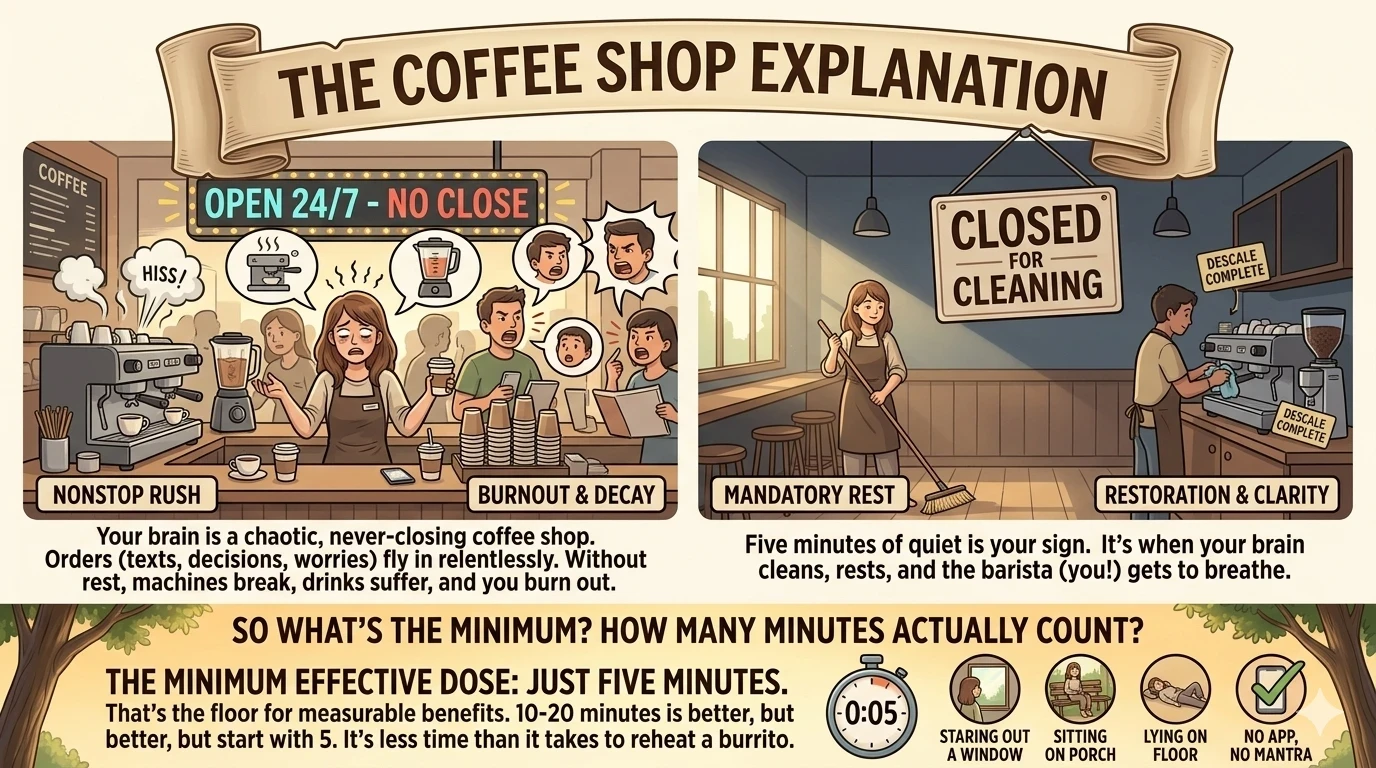
Imagine your brain is a busy coffee shop during the Monday morning rush. Orders are flying in. The espresso machine is hissing. Someone’s blender is going for a smoothie. The barista is trying to call out names, make small talk, and steam milk all at once. It’s chaos, but it’s manageable chaos, because that’s what coffee shops are built for.
Now imagine that coffee shop never closes. Never, no overnight hours to restock, clean the machines, and sweep the floor. No quiet stretch to let the barista catch her breath. Just an endless, nonstop rush, day after day, year after year.
That coffee shop would fall apart. The machines would break down. The staff would burn out. The quality of every drink would slowly get worse, even if nobody could point to the exact moment it happened.
Your brain is that coffee shop. And most of us never close it. We just keep taking orders, texts, notifications, news, decisions, worries, from the second we wake up until the second we fall asleep, and sometimes even then. Sitting quietly and doing nothing is your “closed for cleaning” sign. It’s the only time the espresso machine gets descaled, the counters get wiped, and the barista gets to breathe.
So What’s the Minimum? How Many Minutes Actually Count?
Here’s the actual number you came this far for: five minutes a day is the realistic and actual minimum where researchers start seeing measurable benefits in stress and mental clarity. Some studies find noticeable changes in heart rate and stress hormones in as little as five to ten minutes of quiet, unstructured rest. If you can stretch that to ten or twenty minutes, the benefits get stronger, but five minutes is the floor, the minimum effective dose, so to speak.
That’s it. Five minutes. Less time than it takes to microwave a frozen burrito and let it rest before you eat it.
The key focus word here is quiet, not meditation or brainstorming. You don’t need an app. You don’t need a mantra. You don’t need to sit cross-legged on a $40 cushion because an influencer told you to. You just need five minutes where you’re not doing, consuming, or producing anything. Staring out a window counts. Sitting on your porch counts. Lying on the floor and looking at the ceiling counts.
The Science Behind Why This Works (Explained Without the Jargon)
Let’s talk about why five minutes of nothing actually does something. I promise to keep this simple, because honestly, that’s how I understand it too.
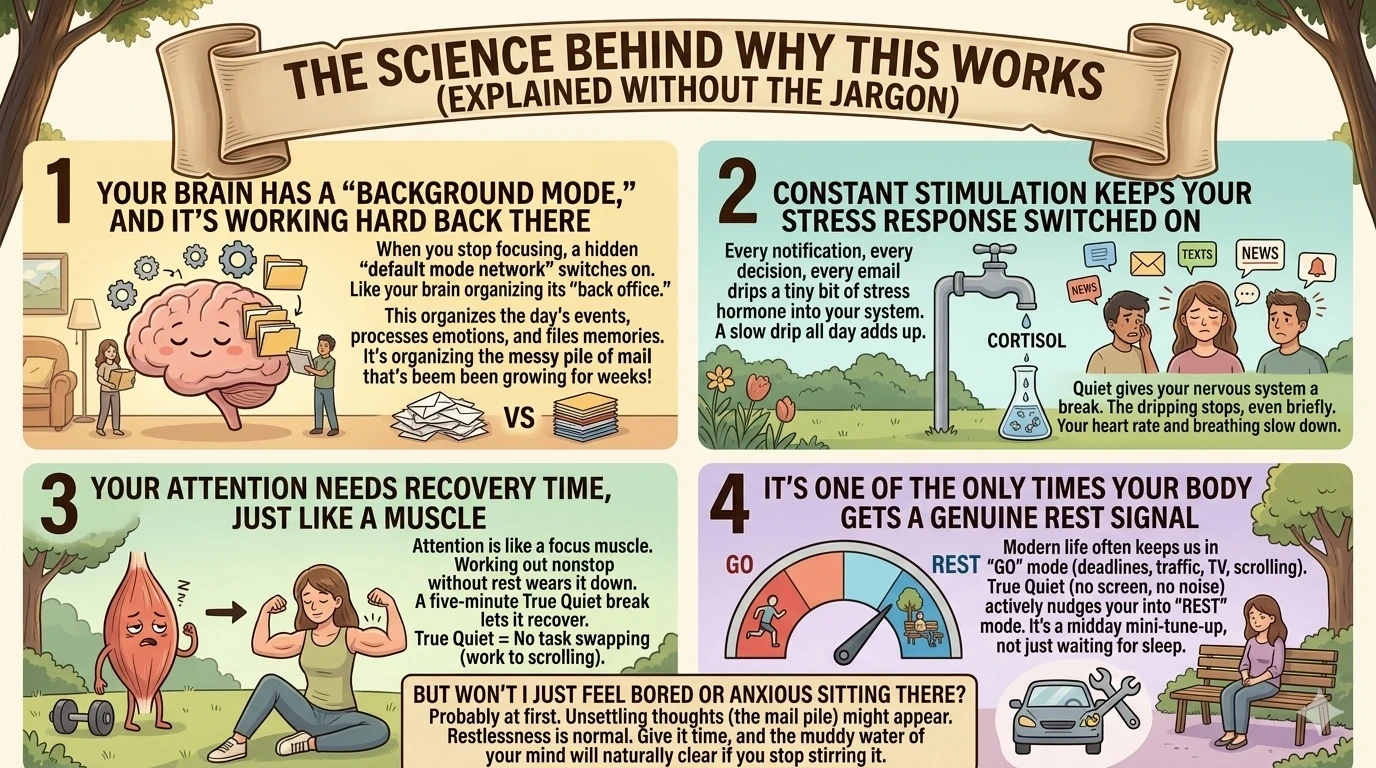
1. Your brain has a “background mode,” and it’s working hard back there
When you stop focusing on a task and let your mind wander, a network in your brain sometimes called the “default mode network” switches on. Scientists used to think this was just your brain idling, like a car at a red light. Turns out it’s more like your brain going into the back office to do paperwork.
This background mode is where your brain sorts through the day, connects ideas, processes emotions, and files away memories. It’s the mental equivalent of finally organizing the pile of mail that’s been sitting on your kitchen counter for two weeks. If you never give your brain quiet time to do this, the pile just keeps growing, and eventually you can’t find anything in it.
2. Constant stimulation keeps your stress response switched on
Every notification, every quick decision, every “just one more email” keeps a low level of stress hormone trickling into your system. It’s usually not enough to feel like an emergency. It’s more like a slow drip. But a slow drip all day, every day, adds up.
Sitting quietly, even for a few minutes, gives your nervous system a chance to downshift. Your heart rate can drop a little. Your breathing slows down. It’s the difference between a faucet dripping all day and someone finally turning the handle off, even briefly.
3. Your attention needs recovery time, just like a muscle
Think about your focus like a muscle at the gym. If you did bicep curls nonstop for eight hours with zero rest, your arm wouldn’t get stronger. It would just get exhausted and stop responding. Attention works the same way. Constant focus without breaks doesn’t build sharper focus, it wears it down.
Short stretches of true quiet, where you’re not swapping one task (work) for another task (scrolling), let your attention recover. That’s part of why a five-minute pause can leave you sharper for the next hour, even though it feels like you “lost” five minutes.
4. It’s one of the only times your body gets a genuine rest signal
Your nervous system has two main modes: the “go” mode that gets you through deadlines and traffic, and the “rest” mode that repairs and recharges you. Most of modern life keeps us stuck in the “go” mode, even when we’re technically relaxing on the couch, because the TV, the phone, and the scrolling all keep feeding the same alert circuits.
True quiet, no screen, no noise, no task, is one of the few reliable ways to nudge your body into “rest” mode on purpose. You’re not waiting for sleep to do all the repair work. You’re giving your body a mini tune-up in the middle of the day.
But Won’t I Just Feel Bored or Anxious Sitting There?
Probably, at first. And that’s normal. If you’ve never let your coffee shop close, the first quiet moment can feel completely unsettling. Thoughts you’ve been outrunning all day might finally catch up to you. That’s not a sign you’re doing it wrong. That’s the mail pile finally getting sorted.
Give it a few tries. Most people find that after the first minute or two of restlessness, something shifts. The noise in your head quiets down, even if just a little. You don’t have to force your mind to be calm. You just have to stop feeding it new stimulation and let it settle on its own, the way muddy water clears if you just stop stirring it.
What Counts as “Doing Nothing” (And What Doesn’t)
This is the part people usually get wrong, so let’s clear it up. “Doing nothing” does not mean scrolling social media with the sound off. It does not mean watching TV with the captions on so it feels quieter. It does not mean listening to a podcast about productivity while you sit on the porch. Those are all still inputs. Your brain is still taking orders at the counter, just a little slower.
True quiet time means no screens, no headphones, and no new information coming in. Here’s a quick way to think about it: if you could describe what you just consumed to a friend, it wasn’t quiet time. If nothing happened except your own thoughts drifting around, that’s the real thing.
A few examples that count:
- Sitting on a porch or balcony and watching the yard, the street, or the sky
- Lying on the floor or a bed with your eyes open or closed, no phone nearby
- Sitting in your parked car for a few minutes before going inside, engine off, radio off
- Standing at a window with a cup of coffee, not looking at your phone
- Sitting quietly outside, even in a plastic lawn chair, just noticing the weather
A few examples that don’t count, even though they feel restful:
- Scrolling Pinterest or Instagram, even for “relaxing” content
- Watching TV, even something calm like a nature documentary
- Listening to a podcast, audiobook, or music with lyrics
- Reading the news “just for a minute”
None of these things are bad on their own. They’re just not the same as quiet. Your coffee shop is still open for all of them, just running a slower shift.
Why Five Minutes Doesn’t Feel Like Enough (But Is)
A lot of people hear “five minutes” and assume it’s a nice idea in theory, but must be too small to actually matter. I get the skepticism. In a culture that measures workouts in hours and self-care in spa days, five minutes can feel like a rounding error.
But think about it this way. Nobody expects one glass of water to fully rehydrate you for the week. It doesn’t work that way, and nobody expects it to. It works because it’s one small, repeated deposit that adds up over time. Five minutes of quiet works on the same principle. It’s not one heroic reset. It’s a small, repeatable deposit into your nervous system’s savings account, made daily instead of all at once.
The five-minute number matters for another reason too: it’s inconsequential enough that almost nobody can truthfully say they don’t have time for it. A one-hour meditation retreat is a nice idea that never happens for most working people. Five minutes squeezed between the driveway and the front door is realistic. And realistic beats ideal, because realistic is the version you’ll actually do tomorrow, and the day after that.
What Happens If You Skip It for a Few Days
You won’t fall apart if you miss a day, or even a week. This isn’t medicine with a strict dosage schedule. But most people who have tried this notice a pattern: the days they skip quiet time entirely tend to be the days that feel the most scattered by evening. Small decisions feel heavier. Patience runs thinner. It’s subtle, not dramatic, which is exactly why it’s easy to overlook.
Think back to the coffee shop. Skipping one nightly cleaning doesn’t shut the place down. But skip it for two weeks straight, and the machines start acting up, the counters get sticky, and the whole operation feels a little more chaotic than it needs to be. Five minutes a day is cheap maintenance. Skipping it doesn’t cause a crisis, but it quietly raises the baseline hum of stress you’re carrying around without realizing it.
Why This Fits Right Into a Budget-Conscious Life
Here’s what I love about this particular piece of self-care: it costs nothing. Zero dollars. No subscription, no gadget, no supplement, no fancy retreat. In a world where wellness often gets sold to us in a bottle or an app with a monthly fee, quiet stillness is refreshingly free.
You don’t need a meditation cushion, a white noise machine, or a $200 pair of noise-canceling headphones, though any of those are nice if you already have them. All you need is five minutes and a willingness to not check your phone during them. That’s a budget-friendly form of self-care that fits into literally any life, any income, and any schedule.
Three Practical, Low-Cost Takeaways You Can Do Today
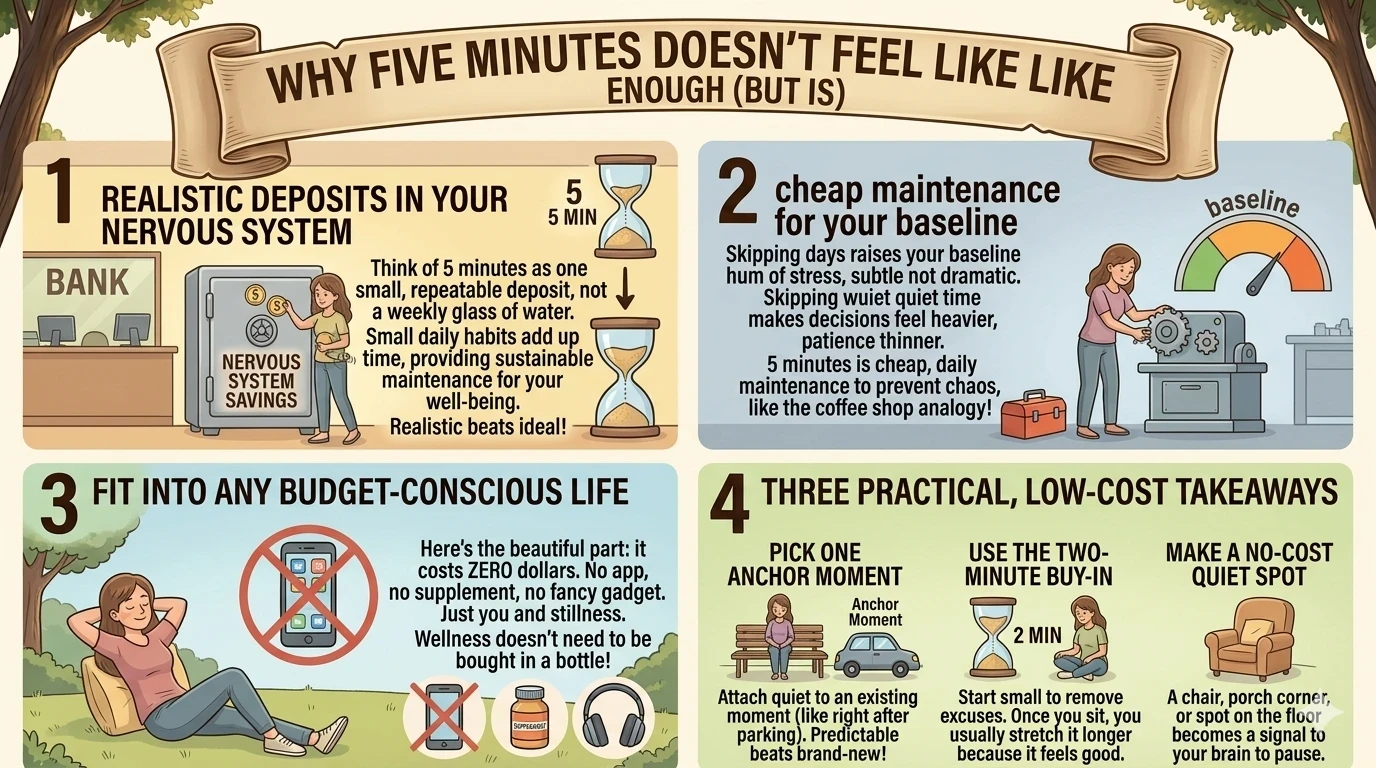
1. Pick one “anchor moment” and protect it
Don’t try to overhaul your whole day. Just pick one moment that already exists, right after you park the car before you go inside, the first five minutes after the kids leave for school, or right before you brush your teeth at night. Sit there, phone in another room if possible, and just be quiet. Attaching quiet time to something you already do makes it far more likely to stick than trying to build a brand-new habit from scratch.
2. Use the “two-minute buy-in” trick
If five minutes feels like too big of an ask on a busy day, tell yourself you only have to sit quietly for two minutes. Almost everyone can find two minutes. What usually happens is that once you’re sitting there with nothing to do, you naturally stretch it longer because it feels better than you expected. Starting small removes the excuse of “I don’t have time” and lets the habit build itself.
3. Make a “no-cost quiet spot” in your home
You don’t need a meditation room. Pick one chair, one corner of the porch, or even one spot on the floor that becomes your designated “do nothing” spot. It doesn’t need decorations or special lighting. The goal is just to have a place your brain associates with pausing, so that sitting down there becomes a signal to your nervous system that it’s allowed to power down for a few minutes.
The Bottom Line
You don’t need an hour. You don’t need incense, an app, or a retreat in the mountains. You need five minutes, an empty chair, and permission to do nothing at all. Your brain has been running a coffee shop that never closes, and it’s asking, quietly, for you to flip the sign to “closed” for just a few minutes a day.
Give it that. Your future self, the one who isn’t running on fumes by 3 p.m., will thank you.

I really liked your “two-minute buy-in” trick, since it completely removes the mental block of feeling like you don’t have a full five minutes to spare on a hectic day. When I try to force myself to sit still, my brain usually rebels and I end up grabbing my phone just to check one quick thing, which completely defeats the purpose.
How do you usually handle those first couple of restless minutes when your mind is still racing from whatever task you just dropped?
I’d love to hear if you have a gentle way to acknowledge those lingering thoughts without letting them pull you back into the noise.
Thanks Ropata, I always have to remind myself to enjoy some quiet time. Crazy to think it something you have to plan for. Always best to plan it out at the start of the day, or like I do just wake up have breakfast then take 5-15 minutes to get mentally ready for the day.