
🌿 Urban Foraging: The Simple, Fun Way to Reconnect With Real Food in the Modern World

Somewhere between grocery stores, delivery apps, and drive-thru windows, most people lost something important:
A basic awareness of where food actually comes from.
Not in a philosophical way. In a practical, everyday way.
We know how to tap a phone and get dinner in 30 minutes. But we don’t always know what’s growing in the cracks of a sidewalk, what’s edible in a park, or how much free food is quietly living in plain sight all around us.
That’s where urban foraging comes in handy.
It’s not survivalism. It’s not even that extreme. And it’s definitely not about abandoning modern life.
It’s about something much simpler:
Learning to notice the edible world that already exists around you—and reconnecting with food in a more direct, hands on, curious, and grounded way.
And surprisingly, it’s becoming a quiet trend again. https://mashable.com/article/how-to-start-urban-foraging

🌍 What Is Urban Foraging?
Urban foraging is the practice of finding and gathering edible plants, herbs, fruits, and sometimes mushrooms in city or suburban environments.
That might include:
- wild berries growing along trails
- herbs like mint or dandelion in parks
- fruit trees in neighborhoods or public spaces
- edible weeds growing in gardens or sidewalks
It’s basically the modern version of something humans have always done—except now it happens between coffee shops and parking lots instead of forests and fields.
The key idea isn’t “living off the land.”
It’s this:
Even in a modern city, nature is still producing food—you just have to learn how to recognize it.

🧭 Why Urban Foraging Is Starting to Trend Again
Urban foraging isn’t new. What’s new is the reason people are interested in it again.
It’s showing up in conversations about:
- real food living
- sustainability
- wellness burnout
- simple living
- “get off your phone and go outside” culture
But underneath all of that, there’s something deeper happening.
People are tired of feeling disconnected from food.
Urban foraging offers something rare in modern life:
- food that isn’t packaged
- food that isn’t marketed
- food that isn’t engineered
Just plants growing where they’ve always grown.
And that feels surprisingly refreshing in a world of constant consumption.
🧠 The Real Appeal: It’s Not About Free Food
A common misconception is that urban foraging is just all about “free groceries.”
That’s not really what keeps people interested.
The real appeal is psychological.
Urban foraging does something modern food systems rarely do:
It slows you down.
Instead of grabbing food from a shelf, you start noticing:
- textures of plants
- seasonal changes
- where sunlight hits sidewalks
- what grows after rain
- how different neighborhoods support different plant life
Food stops being something you “buy.”
It becomes something you observe and appreciate first.
That shift alone changes how people relate to eating.
🌿 Urban Foraging as “Real Food Rewilding”
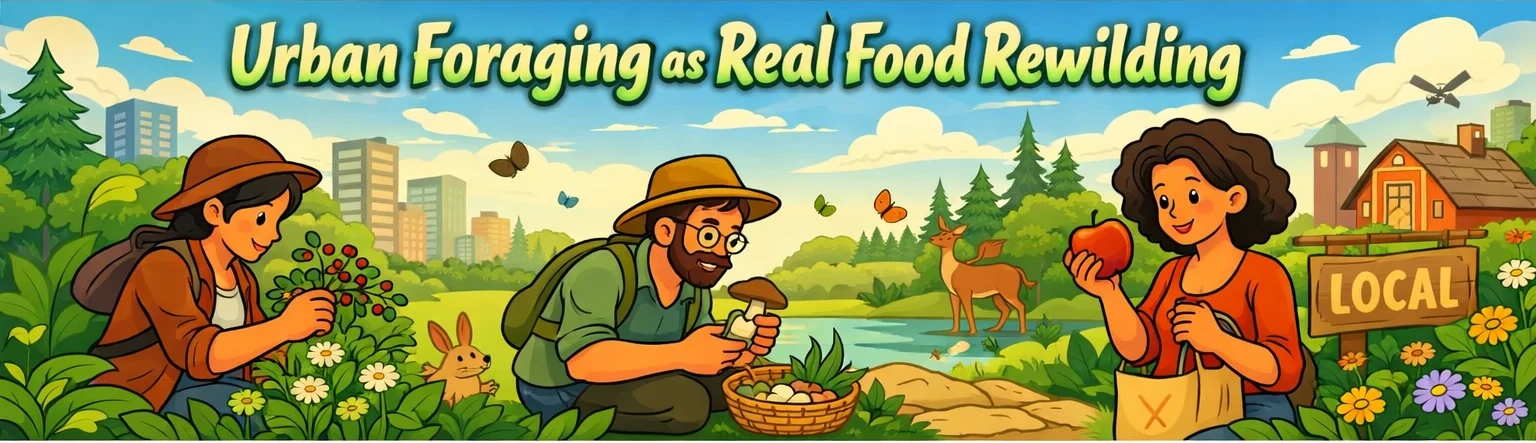
Urban foraging fits perfectly into a broader idea often called Real Food Rewilding—a simple return to more natural eating patterns without rejecting modern life.
You’re not trying to live in the wilderness.
You’re just reconnecting small parts of your daily life to real, unprocessed food sources.
Urban foraging becomes one of the most direct ways to do that because it:
- removes packaging
- removes marketing
- removes industrial processing
- reconnects food with environment
Even if you only forage once in a while, it changes how you see everything else you eat.

🌱 What People Actually Forage in Cities
You don’t need to be an expert botanist to start noticing edible plants.
Some of the most commonly foraged urban foods include:
🌼 1. Dandelion
Often considered a weed, but fully edible.
- leaves can be used in salads
- flowers can be used in tea or simple recipes
- roots can be roasted or brewed
🌿 2. Wild Mint
Often grows near water or shaded areas.
- can be used for tea
- adds flavor to water or dishes
- very easy to recognize by smell
🍇 3. Wild Berries (where available)
Depending on region:
- blackberries
- raspberries
- mulberries
These often grow along trails, fences, or unmanaged areas.
🌳 4. Fruit Trees in Public Spaces
In some cities:
- apple trees
- pear trees
- cherry trees
Many go unnoticed simply because people aren’t looking for them.
🌾 5. Edible Greens (varies by region)
- chickweed
- lamb’s quarters
- purslane
Often overlooked, but surprisingly nutrient-rich.
6. Other more obcure ingredeints Herbs & Aromatics
- Pine Needles: Great for brewing into a vitamin C-rich tea or making infused oils.
- Fennel: Often found growing wild along urban sidewalks and trails; both the fronds and seeds are edible.
- Rosemary & Lavender: Frequently planted as urban landscaping in public spaces or overhanging sidewalk edges.
- Wild Mint: Often thrives near damp city areas, parks, or near leaky public pipes.
🍒 Additional Fruits & Berries
- Figs: Many urban areas have older fig trees hiding in community gardens, alleyways, or overhanging back fences.
- Serviceberries (Juneberries): Highly common city landscaping trees that produce sweet, blueberry-like fruits in early summer.
- Loquats: Very common in warmer urban climates, often grown as ornamental trees but producing delicious, sweet orange fruit.
- Ginkgo Nuts: Found dropped from female ginkgo trees in city parks (though they require careful, thorough processing before eating).
🌻 Edible Flowers & Shoots
- Clover (Red & White): Blossoms can be eaten raw in salads or dried for a sweet, herbal tea.
- Violets: Both the leaves and the vibrant purple flowers are edible, perfect for decorating salads or desserts.
- Bamboo Shoots: Invasive in many city green spaces; young shoots can be harvested in spring and cooked.
⚠️ Additional Safety & Ethics Reminders
- The “Dog Zone” Rule: Avoid harvesting anything growing lower than knee-height along popular walking paths to avoid pet waste contamination.
- Check Local Bylaws: Some cities explicitly ban foraging in public parks, while others encourage it—always know your local regulations.
- Leave Enough for Nature: A good rule of thumb is to never take more than 1/3 of a healthy patch, ensuring the plant can regenerate and feed local wildlife.
⚠️ Important Reality Check: Safety Comes First
Urban foraging is simple—but it requires caution.
Not everything green is edible, and not all environments are safe for harvesting food.
Basic principles include:
- never eat something unless you’re 100% sure what it is
- avoid areas near heavy traffic or pollution sources
- learn from reliable plant identification guides
- start with easy, well-known plants first
This isn’t about rushing. It’s about learning slowly and responsibly.
🚶♂️ How Urban Foraging Changes Your Daily Walks
One of the most interesting effects of urban foraging is how it changes routine movement.
A normal walk might look like:
- headphones in
- eyes forward
- destination-focused
A foraging walk looks different:
- slower pace
- more observation
- attention to ground level
- curiosity about plants and patterns
You start noticing things you previously walked past a hundred times.
A patch of greens becomes interesting.
A fence line becomes a potential food source.
A park becomes a seasonal map.
It turns walking into exploration.
🧭 The “Beginner Mode” Approach to Urban Foraging
You don’t need to transform your lifestyle overnight.
The easiest way to start is with a “Beginner Mode” mindset:
Step 1: Learn 1–2 plants
Don’t overwhelm yourself. Start with something common and easy to identify.
Step 2: Observe before collecting
Spend time just noticing where it grows and how it looks in different stages.
Step 3: Try a very small amount
Only after proper identification and confidence.
Step 4: Repeat
Familiarity builds confidence more than speed.
🧠 Why This Feels So Different From Grocery Shopping
Urban foraging changes something subtle but important:
It removes the layer of separation between you and food.
In grocery stores:
- food is packaged
- origin is abstract
- availability is constant
In foraging:
- food is seasonal
- food is location-based
- food is something you actively notice
That shift creates awareness.
And awareness changes behavior.
People often find that after foraging, they start:
- wasting less food
- choosing simpler meals
- appreciating fresh ingredients more
- questioning processed foods differently
Not because they’re told to—but because perception changes.
🌎 The Cultural Shift Behind Urban Foraging
Urban foraging isn’t happening in isolation. It’s part of a larger shift in how people think about food and lifestyle.
A few overlapping trends include:
1. “Real food” interest is growing
People are increasingly curious about ingredients and processing levels.
2. Digital fatigue is pushing outdoor activity
More people are looking for low-tech, grounding experiences.
3. Sustainability awareness
Even casual interest in reducing waste and food miles contributes to curiosity.
4. Simplicity is becoming valuable again
Fewer steps. Fewer inputs. Fewer layers between action and result.
Urban foraging sits right at the intersection of all of these.
🌿 Is Urban Foraging Just a Trend?
Like many lifestyle movements, it depends how you define “trend.”
If you mean mass adoption, it will probably remain niche.
But if you mean a steady increase in interest, especially among people exploring:
- simple living
- real food eating
- outdoor hobbies
- mindful lifestyle shifts
Then it likely continues growing.
Because it doesn’t require buying anything.
And it doesn’t require rejecting modern life.
It just requires noticing what’s already there.
🧭 Should You Try Urban Foraging?
You don’t need to go all-in to benefit from it.
Even small exposure changes how you see food and nature.
You might start by:
- learning one edible plant in your area
- taking slower walks and observing plant life
- joining a guided foraging walk if available
- growing curiosity rather than urgency
The goal isn’t to replace grocery stores.
It’s to rebuild awareness.
🌿 Final Thought: Food Is Already Around You—You Just Stop Noticing It
Urban foraging isn’t really about collecting wild food.
It’s about shifting attention.
In a world where food is mostly:
- delivered
- packaged
- labeled
- optimized
Foraging reintroduces something simple:
Food that exists independently of systems.
Even if you never gather a single edible plant, the mindset shift is still valuable.
Because once you start noticing the edible world around you, something changes quietly:
Food stops being just something you consume.
And becomes something you’re part of again.
Here is a natural comment you could use:
feels like something many people forgot about as life became more focused on convenience. I like the idea that urban foraging is less about getting free food and more about paying attention to what is around us. There is something valuable about understanding where food comes from instead of only seeing it packaged on a store shelf.
I also think the safety points are important because nature needs respect and knowledge. Foraging sounds simple, but learning what is actually safe to eat makes a big difference. Even if someone never collects wild food regularly, just noticing plants and seasons again seems like a healthier way to connect with the environment.
Thanks Bob! It has become a newly found hobby trying to keep an eye out for many new food options and this has been a creative, fun hobby where I can literally says costs nothing.